
By PulsHealth. Updated
Real data exampleResearch reviewed . Figures use example Apple Health data.
What does Apple Health cardio fitness measure?
VO2 max describes maximal oxygen uptake relative to body mass, in mL/kg/min. Apple Watch estimates it from the heart-rate response to submaximal outdoor activity; it does not measure oxygen in each breath. A clinic can measure oxygen uptake during a graded exercise test, and another app can store that result in the same HealthKit type. Check the source and test metadata before treating them as equivalent. Apple's type documentation explains the distinction.
Why does it update after some workouts but not others?
Apple identifies Outdoor Walk, Outdoor Run and Hiking workouts as opportunities for estimates. Indoor workouts do not qualify for Apple Watch cardio fitness estimates. Adequate motion, heart-rate and location information matters; a completed workout does not guarantee a new estimate. Initial setup can require a day of wear plus several qualifying activities. Apple's current cardio fitness guide describes eligibility and setup.
In the July–September example, 28 estimates appeared on 27 of 92 reporting days. The full reporting year contained 81 estimates on 79 days. Missing days therefore describe recording opportunities, not days of zero aerobic fitness. The more represented source group's median positive gap was about 52 hours, with a longest gap of about 12 days. A second source group contributed only two estimates; its cadence cannot establish a stable schedule.
What do the example values show?
| Window | Records | Median | Recorded range |
|---|---|---|---|
| October 2025–September 2026 | 81 | 48.13 | 41.18–52.22 mL/kg/min |
| July–September 2026 | 28 | 44.45 | 41.95–50.50 mL/kg/min |
These are observed values, not fitness classifications. The focus window differs from the full-year distribution, and the figure preserves the source distinction. Changes may reflect fitness, activity selection, body-mass inputs, medication settings or algorithm changes; this extract does not isolate their effects. Do not read every short-term change as training adaptation.
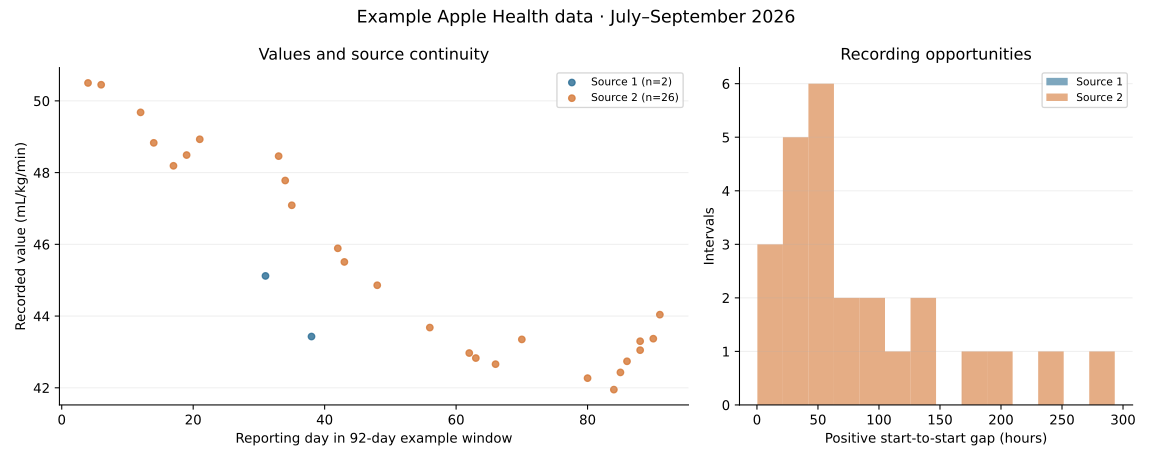
Example values and recording cadence
July–September 2026 example data. Sources shown separately; gaps represent recording opportunities, not physiological cycles or clinical limits.
View full-size figureHow this figure was made
Start-selected records in a fixed reporting calendar; relative reporting-day positions remove exact timestamps. All observations retained. Gap histograms use positive consecutive starts within each source group, including gaps across separate days or workouts. No device identity or causal interpretation is inferred.
How closely do estimates align with recorded workouts?
All example estimates were stored as points. Only 3 of 28 focus timestamps fell inside a recorded workout, but 27 were within ten minutes of a same-bundle workout interval. That proximity is useful context, not proof of a HealthKit workout association. Estimates can be published near the end of activity, so a point outside a workout does not imply a resting VO2 max test.
The type summarizes aerobic capacity; its timestamp does not represent a continuous physiological measurement.
How should I compare it with other fitness measures?
Resting heart rate, walking heart rate and cardio recovery describe different parts of the cardiovascular response. Same-source daily comparisons were investigated, but only 23 focus days paired VO2 estimates with resting heart rate in the larger source group. Recording selection and shared time trends make those comparisons exploratory.
Apple's classifications consider age and sex. Its supported estimate range is a device specification, not a healthy range for everyone. Clinical testing remains a different measurement method. An unexpected persistent change is best reviewed alongside symptoms, workout conditions, source changes and health-profile settings.
How should exported records be summarized?
Use discrete summaries, never sums. Keep test type and source provenance, preserve unrecorded dates as missing, and distinguish sample averages from day averages when a date has multiple estimates. Review retained extremes and neighboring estimates before excluding anything. Stored observations alone cannot establish why a value changed or whether an update recalculated prior results.
Understanding your records
Recording frequency, source and coverage affect what you can conclude from this data. Read the recording guide.
- One record
- Derived discrete estimate; stored intervals do not prove continuous physiological measurement.
- Frequency
- Assess positive start gaps within source groups; a missing day is not zero.
- Context
- Separate source histories and preserve metadata; overlap is temporal context only.
- Coverage and gaps
- Full reporting year and 92-day focus examined; unavailable observations remain missing.
- Summaries
- Use discrete summaries; distinguish samples from reporting days and never sum rates.
- Metadata
- Review optional test/activity metadata and source versions before comparisons.
Recording guidance reviewed 2026-10-14
Reference ranges
These source-specific ranges provide context; they are separate from the personal values in any data examples and do not diagnose a condition.
Interpretation
- normal
- Classification depends on age, sex and test method; no universal cutoff.
| Population | normal |
|---|---|
| Interpretation | Classification depends on age, sex and test method; no universal cutoff. |