
By PulsHealth. Updated
Real data exampleResearch reviewed . Figures use example Apple Health data.
What does one-minute heart rate recovery mean?
Heart rate recovery describes the fall from peak exercise heart rate to the rate one minute after exercise ends. For illustration, a peak of 160 bpm and a one-minute rate of 130 bpm gives a 30 bpm drop. That example explains the concept; it does not reconstruct Apple's estimation algorithm. Apple's HealthKit definition specifies a positive recovery quantity.
A clinic's maximal exercise test and a wearable's submaximal prediction can have different protocols. Keep the recovery test type, activity and source rather than treating every value as the exact difference between two visible heart-rate samples.
When do estimates appear?
The example reporting year contained 56 records on 55 of 365 days. July–September had 17 records on 17 of 92 days. The larger focus source group contributed sixteen records, with a median positive gap of about 96 hours. The other source group had one record, so no interval cadence could be calculated for it.
All seventeen focus estimates were within ten minutes of a same-bundle workout interval, but only two timestamps fell literally inside one. These were point records, not minute-long samples. Proximity suggests workout context; it does not establish an explicit workout UUID link or prove that every workout should produce a record.
What values appeared in the example?
| Window | Median recovery drop | Recorded range |
|---|---|---|
| October 2025–September 2026 | 31.35 bpm | 25.09–43.53 bpm |
| July–September 2026 | 32.47 bpm | 25.09–38.70 bpm |
All 56 year records carried submaximal prediction test type 2, and activity metadata included running, walking and hiking. The analysis retained one source/context IQR flag and reviewed extremes and neighbors. Those observed ranges do not establish a clinical normal range or a target for another workout protocol.
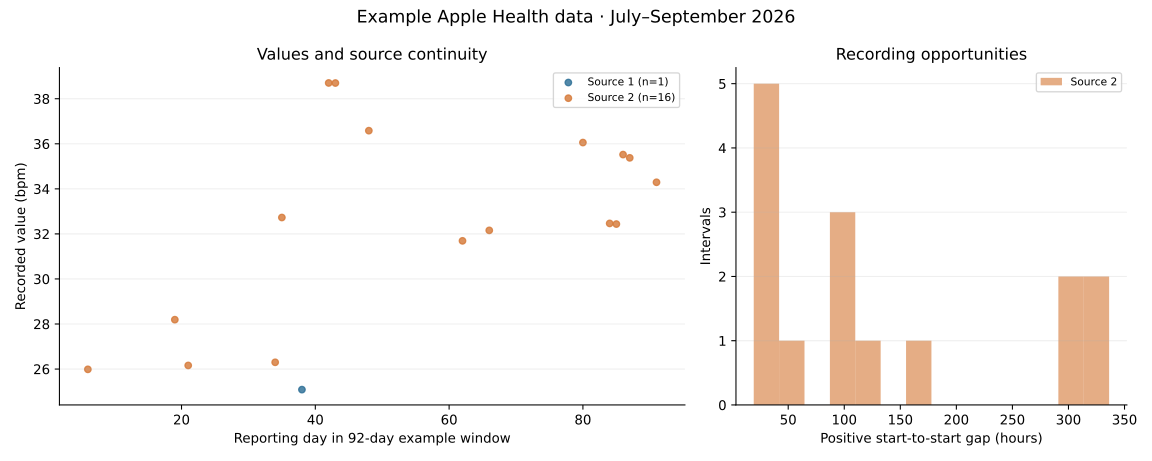
Example values and recording cadence
July–September 2026 example data. Sources shown separately; gaps represent recording opportunities, not physiological cycles or clinical limits.
View full-size figureHow this figure was made
Start-selected records in a fixed reporting calendar; relative reporting-day positions remove exact timestamps. All observations retained. Gap histograms use positive consecutive starts within each source group, including gaps across separate days or workouts. No device identity or causal interpretation is inferred.
Why might the number differ from a manual calculation?
Recorded metadata included a session estimate for 42 of the 56 rows, along with activity duration and, usually, a maximum observed recovery heart rate. A session estimate and the saved recovery quantity are separate fields; do not silently substitute one for the other. Some quantities are encoded as value-plus-unit strings, so inspect units before arithmetic.
Apple's heart-rate measurement guide describes monitoring through exercise and for three minutes afterward. It does not promise that subtracting the nearest exported point exactly reproduces the saved recovery estimate. Intensity, cooldown, posture, signal quality and the test protocol can all affect comparison.
Is a low result a medical threshold?
The frequently quoted 12 bpm or less threshold comes from a 1999 clinical exercise-testing study. Its participants and exercise/recovery protocol differ from everyday wearable estimates. It is evidence that recovery can be clinically meaningful, not a universal diagnosis rule for Apple Health data.
Review persistent unexpected changes with a clinician when appropriate, especially alongside symptoms. A high recovery number alone does not certify cardiovascular health. Avoid assigning “excellent,” “poor” or mortality-risk categories to a wearable estimate without a matching validated protocol.
Which other fitness measurements add context?
The research investigated same-source daily comparisons with resting heart rate, HRV SDNN and VO2 max. Sparse workout-selected dates and confounding make those associations exploratory.
For exported trends, separate sources and test types, keep unrecorded workouts as missing, and use discrete summaries rather than adding recovery drops. The canonical PulsHealth export labels this rate difference in count/min; Apple's type documentation describes count units. Preserve the receiver's unit convention and the meaning of the drop when exchanging data.
Understanding your records
Recording frequency, source and coverage affect what you can conclude from this data. Read the recording guide.
- One record
- Derived discrete estimate; stored intervals do not prove continuous physiological measurement.
- Frequency
- Assess positive start gaps within source groups; a missing day is not zero.
- Context
- Separate source histories and preserve metadata; overlap is temporal context only.
- Coverage and gaps
- Full reporting year and 92-day focus examined; unavailable observations remain missing.
- Summaries
- Use discrete summaries; distinguish samples from reporting days and never sum rates.
- Metadata
- Review optional test/activity metadata and source versions before comparisons.
Recording guidance reviewed 2026-10-14
Reference ranges
These source-specific ranges provide context; they are separate from the personal values in any data examples and do not diagnose a condition.
Interpretation
- normal
- Interpret with the exercise/recovery protocol and test type; clinical thresholds do not directly classify wearable predictions.
| Population | normal |
|---|---|
| Interpretation | Interpret with the exercise/recovery protocol and test type; clinical thresholds do not directly classify wearable predictions. |