
By PulsHealth. Updated
Real data exampleResearch reviewed . Figures use example Apple Health data.
What does Apple Watch HRV actually measure?
Heart rate variability describes how much the time between heartbeats varies. SDNN is the standard deviation of normal-to-normal intervals, expressed in milliseconds. A 60 ms SDNN value is a measure of interval variation, not a heart rate of 60 beats per minute. Apple Watch automatically records discrete SDNN estimates; it does not give this type a universal sampling interval. Apple’s SDNN documentation describes its units and calculation.
SDNN also differs from RMSSD, which summarizes differences between successive intervals. HealthKit added a separate RMSSD type in iOS and watchOS 27. Keep those series separate: there is no fixed conversion between them.
What does a real SDNN record look like?
In the 92-day example below, the data contained 1,236 records across all 92 days, from two Apple Watch source groups. The stored sample span was typically about 59 seconds. Values ranged from 15.1 to 249.2 ms; the median was 52.2 ms and the middle 90% fell between 26.6 and 124.6 ms. These describe the available example estimates, not a healthy range or targets for other people.
The scattered points tell a different story from the daily median. Several estimates on a day can be far apart, and a high point can sit beside much lower neighboring records. The example preserves extremes instead of deleting them as errors. Without the underlying beat intervals, a large value cannot establish unusually good recovery or an optical measurement artifact.
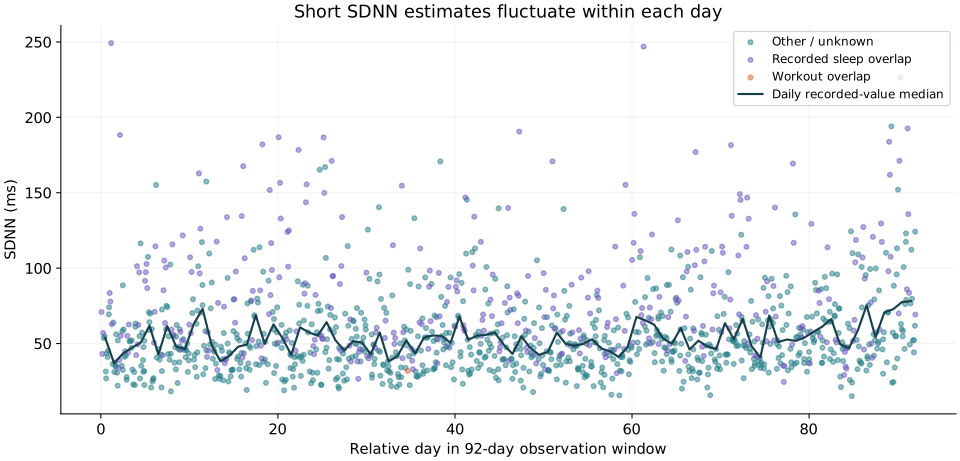
Real SDNN estimates vary within a day
Example data, 1,236 estimates over 92 days. Sleep overlap is temporal context; these values are observations, not population norms. Extremes are retained.
View full-size figureHow this figure was made
All raw SDNN records from two Apple Watch source groups in a 92-day account-calendar window. Values in ms; daily median of recorded estimates. Any half-open overlap with recorded asleep intervals or workouts labels context; other context remains unknown. Relative days replace calendar dates.
How often is HRV recorded?
This example had 11–16 estimates per day, with a median of 14. The pooled median start-to-start gap was about 120 minutes, but individual gaps ranged from roughly 1.4 minutes to 5.9 hours. That is an observation about these sources and this window, not an Apple Watch schedule guarantee.
Start-to-start spacing and the uncovered time after an estimate ends answer different questions. A one-minute sample followed by a two-hour start gap leaves almost two hours without a stored SDNN estimate. A daily average summarizes those short windows; it does not reconstruct continuous HRV or the SDNN of an entire day.
| Question | Check in the records |
|---|---|
| Is the estimate comparable? | Same HRV metric, source and stored duration |
| Is the day well covered? | Count of estimates, their times and uncovered gaps |
| Did the source change? | Source group, software revision and algorithm metadata |
| Is a point unusual? | Context, nearby estimates and source-specific distribution |
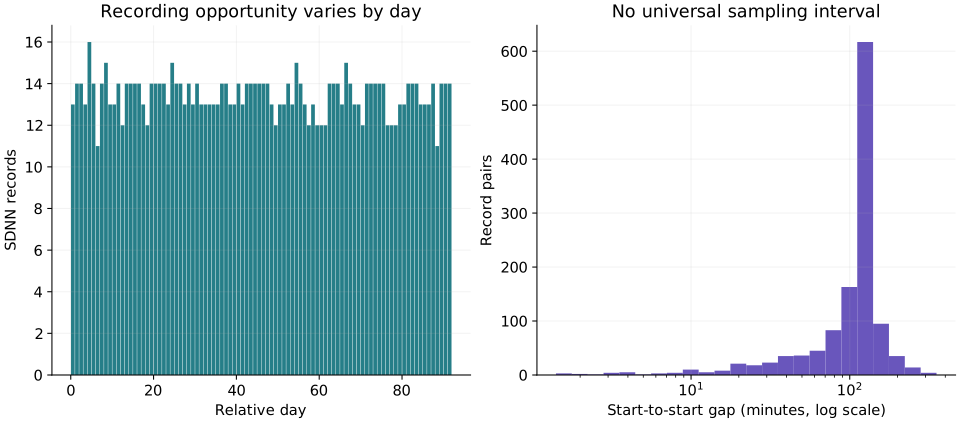
Recording counts and gaps describe coverage
All 92 days contain records, but each day contains short estimates separated by gaps. A two-hour median gap in this example is not a promised device schedule.
View full-size figureHow this figure was made
The same 1,236 SDNN estimates, pooling two source groups. Left: count by account-calendar day, including zero-count days. Right: positive pooled consecutive start gaps in minutes on a logarithmic axis, including changes between contexts and sources. Source-specific and within-episode analyses are retained in the research notebook.
How do sleep and workouts change the picture?
In this example, 342 estimates overlapped recorded asleep intervals, with a median of 69.3 ms. The 893 estimates outside recorded sleep and workouts had a median of 48.4 ms. “Other” means unclassified context; it does not establish that the person was awake, motionless or rested. These comparisons pool sources and different recording opportunities.
Only one estimate overlapped a workout. This dataset cannot support an exercise-versus-rest value comparison or a workout HRV cadence estimate. An empty workout interval means no stored SDNN estimate was found there, not that variability became zero.
For sleep cadence, the analysis required two estimates from the same source fully inside the same contiguous asleep interval. There were 42 qualifying pairs, with a median start gap of about 120 minutes. Gaps between different sleep episodes were kept separate. This avoids calling the daytime between two nights “sleep sampling cadence.”
What can HRV tell you alongside other measurements?
Heart rate and sleep records help explain the context of an HRV trend. Align the time window and source before comparing them; a whole-day heart-rate median may mix dense workout readings with sparse resting readings.
The research behind this example compared same-day medians, repeated comparisons within sleep context and source groups, and aligned daytime SDNN with asleep duration assigned to the waking day. The results depended on that alignment. They do not show that longer sleep caused higher HRV, or justify a recovery score from one measurement. No mindful-session or RMSSD records were available to test those relationships.
Is there a normal Apple Watch HRV range?
There is no single cutoff on this page that labels an Apple Watch SDNN estimate healthy or unhealthy. Recording length, breathing, posture, prevailing heart rate and processing choices affect interpretation. The HRV measurement standards distinguish short recordings from longer recordings; 24-hour Holter risk thresholds should not be applied to these short Watch estimates.
Follow a consistent personal baseline using comparable recordings and display coverage beside the trend. The 2024 measurement guidelines explain why recording method and context constrain physiological conclusions. An unexpected sustained change can be discussed with a clinician, especially alongside symptoms; SDNN alone does not identify a disease or prescribe a training decision.
Understanding your records
Recording frequency, source and coverage affect what you can conclude from this data. Read the recording guide.
- One record
- Each value is an SDNN estimate in time units, not a sequence of individual beat intervals. Inspect the sample start/end span separately from its numeric SDNN value.
- Frequency
- Apple Watch records SDNN samples automatically. The type does not promise a universal interval between records; summarize actual start-to-start gaps by source and observation window.
- Context
- Compare like measurement contexts and durations. Joining an estimate to sleep or a workout requires a stated overlap or proximity rule, not an assumption based only on the type name.
- Coverage and gaps
- Report days with records, records per day and gaps separately. An empty period does not establish absent heart-rate variability or a physiological change.
- Summaries
- Keep SDNN separate from RMSSD and from beat-level series. A daily average summarizes the available estimates; it does not reconstruct continuous or full-day HRV.
- Metadata
- Retain the algorithm-version metadata when present and compare versions separately before attributing a change to physiology. The presence of a version key does not describe the algorithm itself.
Recording guidance reviewed 2026-10-14