
By PulsHealth. Updated
Real data exampleResearch reviewed . Figures use example Apple Health data.
What does respiratory rate mean in Apple Health?
Respiratory rate counts breaths per minute. Apple Watch commonly estimates it during sleep, so an overnight series answers a different question from a clinician counting breathing while awake. Apple’s sleep guide describes overnight respiratory tracking; third-party sources may record other contexts.
A change across several comparable nights can be more useful than an isolated reading. Age, illness, medications, activity and measurement method affect interpretation. The Watch estimate does not diagnose breathing disorders or establish whether an apnea occurred.
What do recorded values and gaps look like?
The example year, October 2025–September 2026, contains 19,306 records on all 365 reporting days. July–September contains 5,069 records on all 92 days, from two source groups. Source revisions were retained; a source grouping does not prove a permanent device identity.
| July–September observation | Example value |
|---|---|
| Median | 15 breaths/min |
| Middle 90% of records | 13.5–19.5 breaths/min |
| Full observed range | 10–34 breaths/min |
| Median records per observed reporting day | 55 |
These are observed values, not a clinical target. The full-year extremes were 7.5 and 35.5 breaths/min. Extremes and source/context-specific IQR flags were retained for review rather than removed or labelled as diagnoses.
All recorded intervals had equal start and end timestamps. This is a stored point estimate, not evidence that the internal sensor measures only at those moments. Within recorded sleep episodes, the median positive gap was 9.48 minutes. Overnight gaps and daytime missingness make a pooled daily average interval misleading.
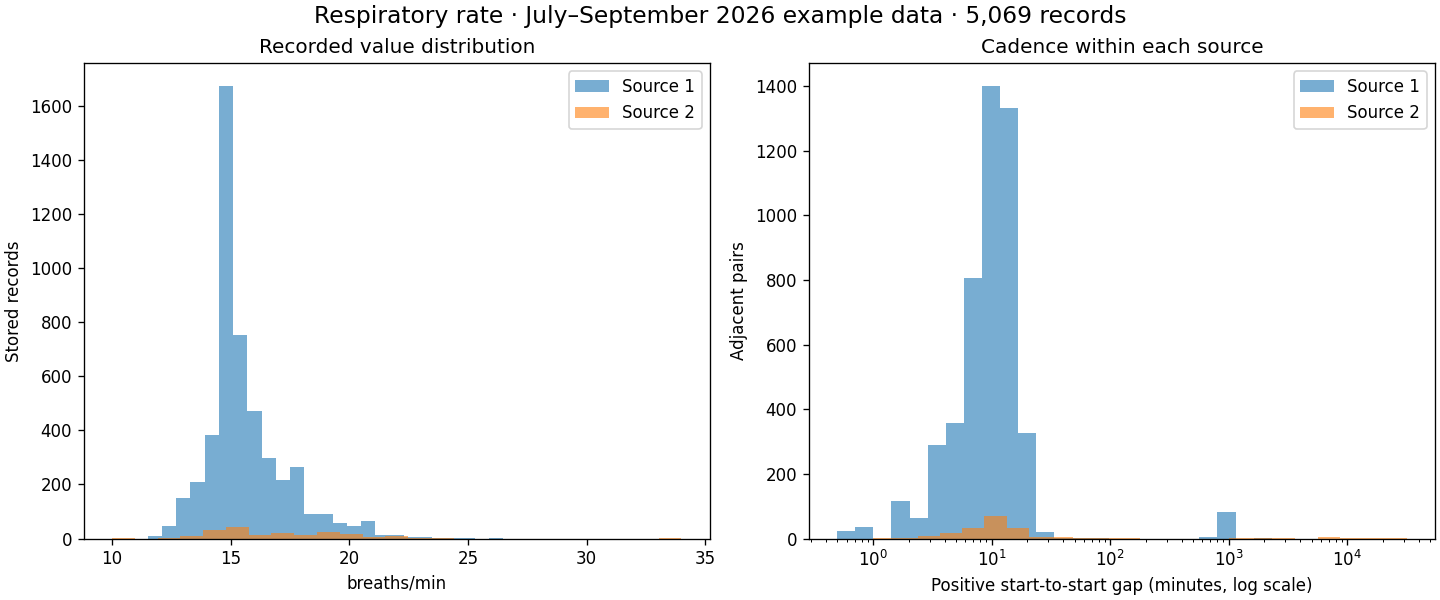
Recorded values and source-specific cadence
5,069 example records, July–September 2026. Source streams remain separate; gaps include unrecorded periods. Breaths per minute; observed values are not clinical reference ranges.
View full-size figureHow this figure was made
Start-selected observations in the fixed reporting calendar. All finite values retained; gaps computed only between adjacent starts within each source group. Source groups combine bundle and display name and do not prove persistent device identity. No timestamps, names or identifiers are published.
How do sleep and workouts change the picture?
Of the 5,069 focus-window records, 4,228 overlapped recorded asleep intervals, 840 had other or unknown context, and just one overlapped a workout. The sleeping median was 15 breaths/min; other/unknown was 17.5. Other/unknown does not establish wakefulness, and differences can reflect sleep coverage and selective recording.
The single workout-overlapping value was 34 breaths/min. That is insufficient to estimate an exercise response or workout recording schedule. Context uses temporal overlap with stored sleep stages and workouts, not an explicit causal association.
Which comparisons are useful?
Compare like-for-like overnight sources over time before mixing all observations into a trend. Respiratory rate and blood oxygen describe different aspects of breathing; one cannot substitute for the other. The research checked source-paired daily medians against oxygen saturation and wrist temperature. Those exploratory comparisons cannot explain an illness, sleep disorder or recovery state; sparse wrist observations especially limit interpretation.
When should a reading prompt attention?
MedlinePlus gives a resting adult reference of 12–18 breaths/min. That clinical context is not an overnight Watch alert threshold. Persistent changes from a comparable baseline, especially with concerning symptoms, deserve clinical discussion. Severe breathing difficulty or chest pain warrants urgent care regardless of the Watch reading.
Why might data be missing or surprising?
Watch wear, sleep tracking, recording eligibility, permissions and third-party source choices affect availability. Missing records cannot identify which factor caused a gap. Do not count missing time as zero breathing, infer sleep quality from sample counts, or promise a universal fixed cadence. Reporting-day coverage uses a fixed calendar and may differ from a travel-local sleep night.
Understanding your records
Recording frequency, source and coverage affect what you can conclude from this data. Read the recording guide.
Reference ranges
These source-specific ranges provide context; they are separate from the personal values in any data examples and do not diagnose a condition.
Adults at rest (clinical reference)
- normal
- 12–18 breaths/min
MedlinePlus reference; not an overnight Apple Watch target or automatic diagnostic threshold.
| Population | normal |
|---|---|
| Adults at rest (clinical reference) MedlinePlus reference; not an overnight Apple Watch target or automatic diagnostic threshold. | 12–18 breaths/min |