
By PulsHealth. Updated
Real data exampleResearch reviewed . Figures use example Apple Health data.
What does blood oxygen saturation measure?
SpO2 estimates the proportion of hemoglobin carrying oxygen. The Apple Watch Blood Oxygen feature provides wellness measurements; it does not replace a clinical assessment. Apple describes on-demand and background recordings, with background frequency depending on activity and measurement conditions.
Why does the database show 0.98 instead of 98?
HealthKit percent quantities use a 0–1 ratio. In this database, a value of 0.98 with unit % means 98%, not 0.98%. Multiply by 100 for the familiar percentage display. Apple’s percent-unit documentation defines this representation. The figure uses percentage presentation; the original records remain unchanged.
What do recorded values and gaps look like?
October 2025–September 2026 contains 8,858 records on all 365 reporting days. The July–September example contains 2,254 records on all 92 days, across two source groups.
| July–September observation | Percentage presentation |
|---|---|
| Median | 98% |
| Middle 90% of records | 95–100% |
| Full observed range | 87–100% |
| Median records per observed reporting day | 24 |
All observations were stored as points with equal start/end timestamps. The source-specific figure preserves differences between recording streams rather than implying a single universal cadence. The focus-window pooled median positive gap was 32.64 minutes; it includes daytime and overnight gaps, so it is not a device sampling specification.
The low values remain in the analysis. A recorded 87% value is neither automatically a verified physiological event nor something to discard as artifact: review source, context, neighboring readings and symptoms. IQR flags describe statistical rarity within a source/context, not clinical significance.
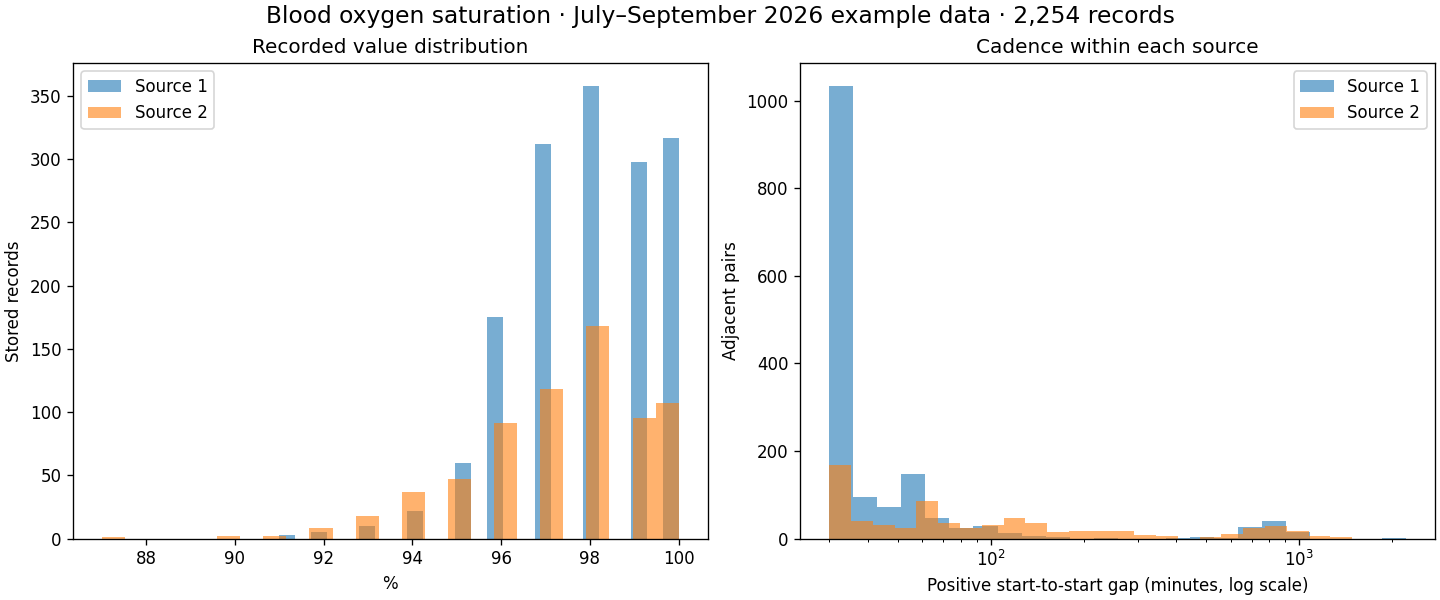
Recorded values and source-specific cadence
2,254 example records, July–September 2026. Source streams remain separate; gaps include unrecorded periods. Oxygen ratios multiplied by 100 for percentage presentation.
View full-size figureHow this figure was made
Start-selected observations in the fixed reporting calendar. All finite values retained; gaps computed only between adjacent starts within each source group. Source groups combine bundle and display name and do not prove persistent device identity. No timestamps, names or identifiers are published.
Is recording different during sleep and exercise?
In the focus window, 1,117 records overlapped asleep intervals and 1,137 had other or unknown context. Both had a median of 98%. The median positive gap within recorded sleep episodes was 30.01 minutes. There were no workout-overlapping records, so the dataset cannot estimate exercise SpO2 or recording during workouts.
Background recording usually favors stillness. This means an all-day sample mean is a summary of successful recordings, not continuous oxygenation. Interval overlap identifies temporal context; it does not prove why a measurement was taken.
How should low readings be interpreted?
Apple describes 95–100% as common and notes that some lower readings can occur during sleep. That does not turn every lower result into a diagnosis. Measurement conditions and health circumstances matter. The FDA’s pulse-oximeter guidance explains accuracy limitations and the importance of symptoms, including effects associated with skin pigmentation and circulation.
For repeated concerning readings, follow a clinician’s advice and use an appropriate clinical device when advised. Significant breathing difficulty, chest pain or bluish lips requires urgent assessment regardless of a reassuring wearable number. Oxygen-treatment targets are individualized; do not use an Apple Watch chart to set or adjust supplemental oxygen.
Why are some nights or devices missing data?
Eligibility varies by model, region, software and setup. Apple’s US feature update describes a redesigned experience for certain models, so older blanket claims of permanent US unavailability are misleading. Sleep recordings require sleep tracking; fit, motion and background settings can also affect success.
Missing samples do not establish normal saturation, non-wear or absent symptoms. Related respiratory rate and wrist temperature can provide context, but source-paired daily associations are observational and cannot diagnose sleep apnea or another disorder.
Understanding your records
Recording frequency, source and coverage affect what you can conclude from this data. Read the recording guide.
Reference ranges
These source-specific ranges provide context; they are separate from the personal values in any data examples and do not diagnose a condition.
General wellness context
- normal
- Apple describes 95–100% as common
Not a diagnosis or treatment target. Clinical circumstances and measurement accuracy matter.
| Population | normal |
|---|---|
| General wellness context Not a diagnosis or treatment target. Clinical circumstances and measurement accuracy matter. | Apple describes 95–100% as common |