
By PulsHealth. Updated
Real data exampleResearch reviewed . Figures use example Apple Health data.
What does resting heart rate mean in Apple Health?
Resting heart rate is an estimated heart rate during rest, in beats per minute. It differs from an ordinary heart-rate sample taken while sitting: sitting just after exercise can still produce a high pulse. Apple estimates resting rate using sedentary readings across the day and may replace recent estimates as more information arrives. Apple's HealthKit documentation describes this refinement.
Apple's measurement technical paper describes selecting inactive waking periods, excluding sleep, and publishing a daily estimate. Another source may use a different method. A timestamp is not necessarily the moment the user took a resting-pulse test.
Why can there be more than one record per day?
The example year contained 532 records on 363 of 365 reporting days. July–September contained 174 records across all 92 days, with two source groups contributing records on 80 shared days. Source grouping uses source name and bundle identifier; it does not prove two simultaneously worn devices.
Each source's median positive start gap was about 24 hours. Pooling both streams would make recording appear more frequent. Multiple rows can reflect source histories and estimate updates; the snapshot alone cannot establish every replacement relationship. Pick a consistent source or explicitly define how to combine sources rather than silently counting all rows as independent days.
What ranges appeared in the example?
| Window | Median | Recorded range |
|---|---|---|
| October 2025–September 2026 | 58 bpm | 46–66 bpm |
| July–September 2026 | 58 bpm | 48–66 bpm |
Both focus source groups had a median of 58 bpm. This is an observed distribution, not a target. Source/context IQR checks flagged ten full-year records for inspection; they were retained, and statistical flags did not diagnose illness or sensor failure. Compare unusual readings with neighboring days and the source history before deciding what they mean.
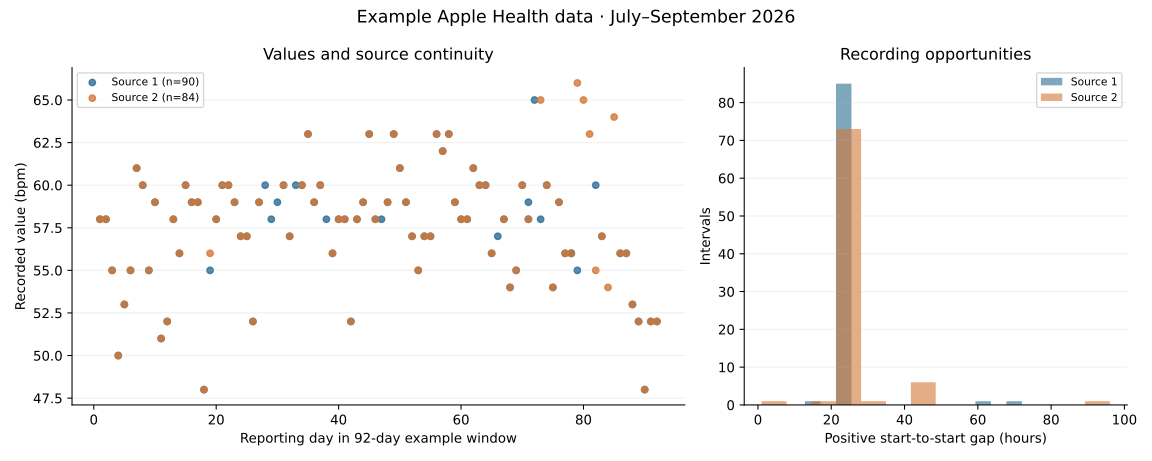
Example values and recording cadence
July–September 2026 example data. Sources shown separately; gaps represent recording opportunities, not physiological cycles or clinical limits.
View full-size figureHow this figure was made
Start-selected records in a fixed reporting calendar; relative reporting-day positions remove exact timestamps. All observations retained. Gap histograms use positive consecutive starts within each source group, including gaps across separate days or workouts. No device identity or causal interpretation is inferred.
Is resting heart rate the same as sleeping heart rate?
No. Sleeping heart-rate samples describe pulse during sleep; Apple's resting estimate is built from waking rest. In the example, stored resting-rate intervals had a median duration of about 23.9 hours. Those broad daily intervals overlapped sleep and workouts even though the value did not measure either activity throughout the interval.
Consequently, sorting these rows into “during sleep” and “during workout” would be misleading. Use actual heart-rate samples matched to sleep intervals or workouts for that question. A daily resting estimate can still be compared with the preceding night's sleep, provided the reporting date and source are explicit.
How should I interpret changes?
For most adults, the American Heart Association describes 60–100 bpm as a usual resting range; trained people and people taking some medications can be lower. This guidance is not a diagnostic cutoff for an exported daily estimate.
Review a sustained change alongside illness, recovery, medication, sleep and wear patterns. Resting rate alone cannot diagnose overtraining, infection or an arrhythmia. New concerning symptoms such as fainting or chest pain deserve medical attention independently of the graph.
Which other measurements add context?
HRV SDNN, walking heart rate and VO2 max provide complementary information. The research compared same-source daily medians rather than mixing devices or treating dense raw pulse samples as equivalent daily estimates. Associations do not establish a cause or a recovery score.
Keep this type discrete: average, minimum, maximum or most recent are meaningful summaries; adding daily bpm values is not. Preserve missing days and disclose the source/date selection behind rolling averages.
Understanding your records
Recording frequency, source and coverage affect what you can conclude from this data. Read the recording guide.
- One record
- Derived discrete estimate; stored intervals do not prove continuous physiological measurement.
- Frequency
- Assess positive start gaps within source groups; a missing day is not zero.
- Context
- Separate source histories and preserve metadata; overlap is temporal context only.
- Coverage and gaps
- Full reporting year and 92-day focus examined; unavailable observations remain missing.
- Summaries
- Use discrete summaries; distinguish samples from reporting days and never sum rates.
- Metadata
- Review optional test/activity metadata and source versions before comparisons.
Recording guidance reviewed 2026-10-14
Reference ranges
These source-specific ranges provide context; they are separate from the personal values in any data examples and do not diagnose a condition.
Adults at rest
- normal
- Usually 60–100 bpm; trained adults and some medications can produce lower rates. A daily estimate is not a standardized clinical pulse test.
| Population | normal |
|---|---|
| Adults at rest | Usually 60–100 bpm; trained adults and some medications can produce lower rates. A daily estimate is not a standardized clinical pulse test. |