
By PulsHealth. Updated
Real data exampleResearch reviewed . Figures use example Apple Health data.
What does a Low Heart Rate Event mean?
A Low Heart Rate Event records a low-rate notification from Apple Watch. It is not the same thing as every low Heart Rate sample. The category value 0 (notApplicable) identifies the event; the configured beats-per-minute threshold appears in separate metadata. Apple's HealthKit documentation describes these samples as read-only.
When does the watch record a notification?
Apple Watch can notify you when your rate remains below the chosen threshold after at least ten minutes of apparent inactivity. See Apple's heart-health guide. This setting is not a personalized medical assessment. A rate below a clinical definition of bradycardia does not guarantee a watch notification, and a saved event does not establish a conduction disorder.
Low rates can occur during sleep or in physically trained people. Their significance depends on symptoms, baseline, medications and other clinical context. The American Heart Association's bradycardia guidance discusses these differences. Sleep overlap alone cannot certify that an event is harmless.
What did the example records show?
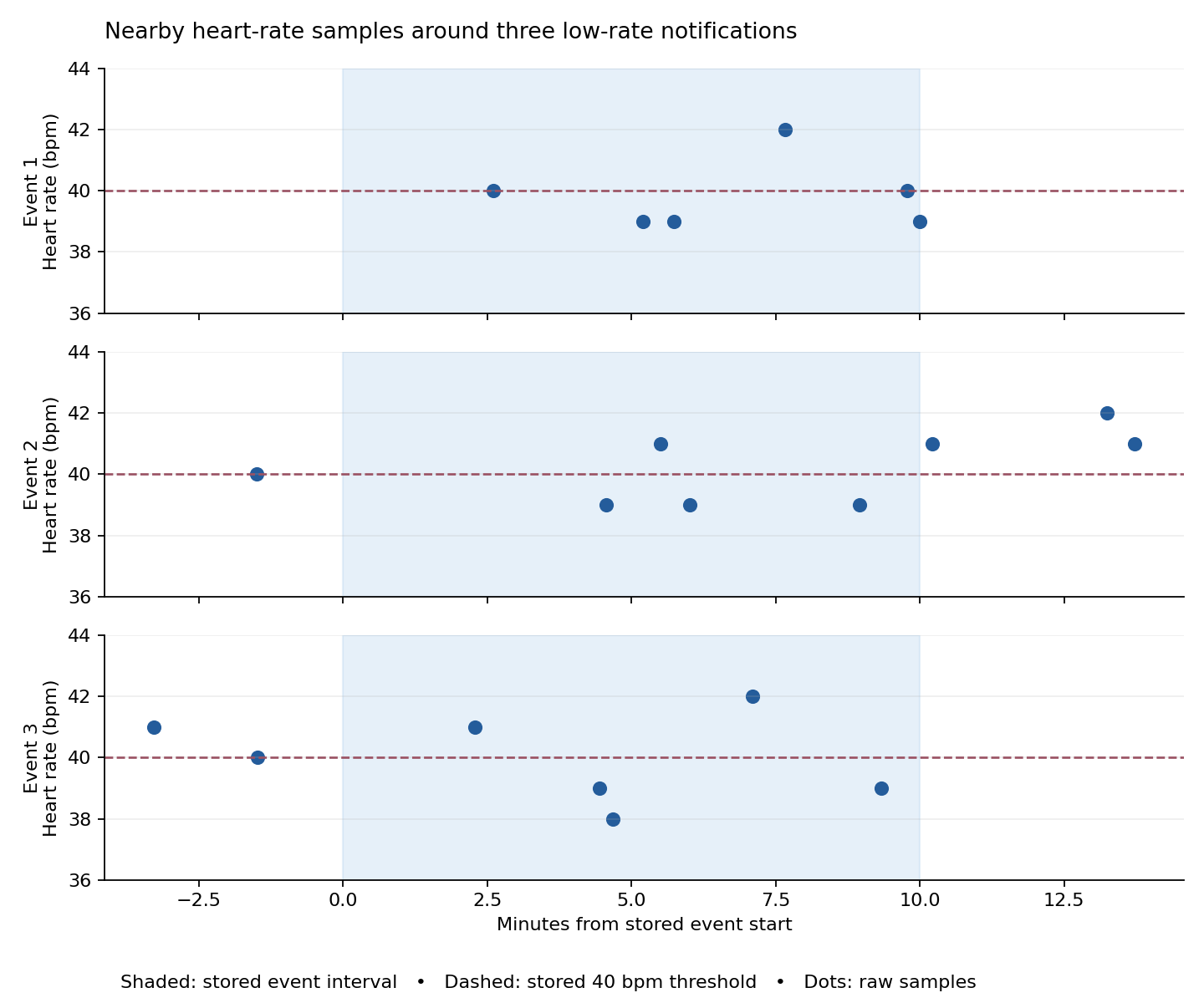
The October 2025–September 2026 window contained three events on three dates, all from the same source revision. All used category code 0 and stored a 40 bpm threshold. Each stored interval was exactly ten minutes. No events appeared in the July–September focus window.
| Event in chronological order | Stored interval | Nearby pulse samples | Nearby pulse range |
|---|---|---|---|
| 1 | 10 minutes | 6 | 39–42 bpm |
| 2 | 10 minutes | 8 | 39–42 bpm |
| 3 | 10 minutes | 7 | 38–42 bpm |
Nearby samples here start within five minutes before the event start through five minutes after its end. They are a temporal comparison across exported heart-rate sources, not an explicit HealthKit association. The ten-minute record is not evidence that every instant stayed below 40 bpm. Three notifications do not support stable percentiles, a typical event rate or a disease-risk estimate.
An event interval is different from continuous pulse data
Example data: three saved low-rate notifications, each with a 40 bpm threshold and a ten-minute interval. Dots are the 6, 8 and 7 nearby pulse samples. All three intervals overlap recorded sleep; none overlap a recorded workout. These sparse examples do not establish a normal range or cause.
View full-size figureHow this figure was made
October 2025–September 2026 snapshot. Events ordered by time with dates and source identity removed. All exported heart-rate sources; samples selected by start from five minutes before event start through five minutes after event end. No interpolation. Shading shows stored intervals, not validated bradycardia duration. Temporal proximity is not an explicit HealthKit link.
How did the events relate to sleep and workouts?
All three event intervals overlapped a recorded asleep interval; none overlapped a recorded workout. That is a description of these examples, not a rule that low notifications only happen during sleep. The stored intervals and nearby readings cannot identify the cause of a low rate.
The long gaps between saved events describe notification timing. They do not show continuous monitoring, uninterrupted normal readings or time without bradycardia. Notification settings and watch-wear opportunities on days without an event were unavailable.
Which related measurements help?
Use raw heart rate to examine the surrounding readings and Resting Heart Rate to follow a different daily summary. Sleep Analysis supplies recorded context. An available ECG may capture electrical rhythm, but a recording at another time cannot explain the event retrospectively.
The database had no AFib-burden records and no VO2-max estimates in these event comparison windows. That does not exclude AFib or establish fitness as the explanation. An irregular-rhythm notification or a high-rate event nearby also does not independently diagnose a rhythm syndrome.
What should you do with a concerning notification?
Discuss new, recurring or symptomatic episodes with a clinician. A sudden unusually slow pulse accompanied by chest pain, breathlessness, dizziness or fainting needs urgent assessment; see the AHA heart-rate guidance. Do not change medication or dismiss symptoms based on a sleep label, fitness score or watch threshold alone.
Understanding your records
Recording frequency, source and coverage affect what you can conclude from this data. Read the recording guide.