
By PulsHealth. Updated
Real data exampleResearch reviewed . Figures use example Apple Health data.
What does active energy mean in Apple Health?
Active Energy Burned is estimated energy from physical activity, above resting energy. It includes everyday movement as well as exercise. On Apple Watch it contributes to the Move ring. Apple's HealthKit definition explicitly excludes the resting calories burned during the same interval.
A food Calorie and a kilocalorie are the same unit here: 1 kcal = 4.184 kJ. A 4-kcal sample means four estimated calories over its recorded interval; it does not mean four calories per minute or four calories for the entire day.
| View | What it represents | How to use it |
|---|---|---|
| Raw sample | Energy assigned to an interval | Inspect duration and source |
| Daily statistics | HealthKit-computed cumulative total | Keep the requested calendar and source filter |
| Move ring | Recorded daily activity summary | Use the summary rather than reconstructing it from raw rows |
| Active plus resting energy | Two complementary estimates | Align periods and source handling before adding |
Why do calorie records arrive at different intervals?
The database example contains a full reporting year and a July–September focus. The largest Apple-health source group supplied 71,012 active-energy intervals across all 92 focus days. The median interval was about 2.57 seconds during workout overlap and 30.8 seconds for other or unknown context. Some intervals lasted roughly ten minutes. Stored interval boundaries describe how estimates are saved, rather than a fixed calorie-sensor sampling frequency.
Apple notes that active-energy records can be condensed or coalesced. Software versions and competing sources can therefore change both the number and size of records. Comparing the mean raw sample before and after a device change can manufacture a trend even when daily activity is similar.
What changes during workouts and recorded sleep?
The focus sample amounts ranged from 0.001 to 73.074 kcal. That range mostly answers how much energy an interval contains. Dividing each amount by its positive duration makes the workout comparison more useful: the median interval-average rate was 9.49 kcal/min for workout overlap and 0.74 kcal/min for other or unknown context.
The largest selected-source amount, 73.074 kcal, covered about ten minutes: an average of 7.33 kcal/min. A large amount was therefore not the largest interval-average rate.
These are example estimates, not targets or validated measurements of expenditure. The figure weights each stored interval equally, so densely recorded workouts contribute many more observations. A record is assigned by overlap with a workout; that is not proof of a HealthKit workout association.
Recorded-sleep overlap contributed only 79 intervals on six focus days. This is too limited to describe a dependable overnight active-energy range. A small positive active-energy interval near sleep can reflect movement or an interval crossing a sleep boundary; it is not evidence of a sleep disorder.
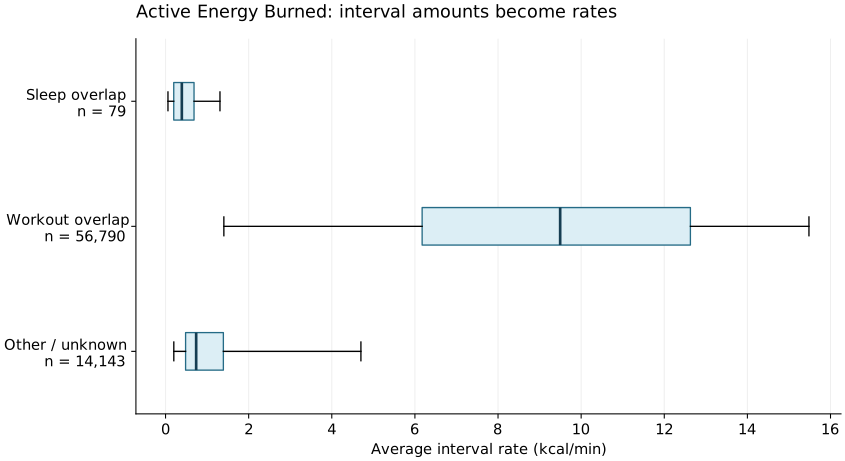
Recording context changes interval-average energy rates
Selected-source example data: 56,790 workout-overlap intervals on 48 days, 14,143 other or unknown intervals on 92 days, and 79 sleep-overlap intervals on only six days. Amount divided by duration gives an interval-average rate, not an instantaneous measurement or a target range.
View full-size figureHow this figure was made
July–September 2026, fixed America/Los_Angeles reporting calendar. Largest Apple-health source group by record count, bundle/name grouping across source revisions. Amount divided by positive duration of at least one second. Boxes span p25–p75 with median; whiskers p5–p95. Extreme intervals retained in analysis but omitted from this display. Each interval weighted equally. Half-open overlap with workouts and asleep categories 1/3/4/5; other/unknown is not confirmed rest or wakefulness.
Why does a raw total differ from the Move ring?
There were four contributing source groups in the year. Even within the selected group, overlapping records were present. Adding every source and every overlapping sample can count overlapping estimates more than once.
The selected-source sum, assigning each complete interval to its start day, matched the recorded Move ring within 0.01 kcal on just 3 of 365 paired dates. This diagnostic comparison mixes a fixed reporting calendar with the phone's recorded ring dates and omits other source groups. It does not show that the ring is wrong. Daily statistics also use their own bucket boundaries and source handling; travel-related calendar differences must be checked before pairing days.
For a Move-ring question, use Activity Summary. For a raw-data question, retain sources, durations and overlap diagnostics. Do not add a workout's calorie total on top of daily active energy when the same activity is already included.
How should ranges, outliers and trends be interpreted?
There is no universal healthy active-calorie range. Body size, activity, recording coverage and the estimation model all influence the result. A large sample can simply span a longer interval. Review its duration, source and neighboring records before labeling it unusual; retain it unless there is evidence of a recording problem.
Apple recommends keeping personal information current, checking watch fit, selecting the appropriate workout and calibrating the watch. Calorie estimates are useful for comparing similarly recorded weeks, but the database does not contain calorimetry against which to validate them.
The selected-source daily sums tracked Exercise Time more closely than Basal Energy: exploratory rank correlations were 0.88 across 352 paired days and 0.33 across 365 days, respectively. Shared sensors, algorithms and recording opportunity contribute to those relationships. Neither correlation identifies calories caused by exercise or establishes an energy deficit from dietary logs.
Understanding your records
Recording frequency, source and coverage affect what you can conclude from this data. Read the recording guide.