
By PulsHealth. Updated
Real data exampleResearch reviewed . Figures use example Apple Health data.
What does Walking + Running Distance include?
This HealthKit quantity measures distance moved by walking or running. It is a cumulative length, stored here in meters. iPhone and Apple Watch can record it automatically; it is broader than the distance from a single saved workout. Apple’s type documentation also notes that HealthKit may condense or coalesce samples.
| Record or summary | Meaning | Appropriate comparison |
|---|---|---|
| Raw interval | Distance attributed to an interval | Other intervals from the same source |
| Daily total | Cumulative distance after source selection | Comparable reporting days |
| Workout distance | Distance reported for a saved workout | That workout’s route and activity context |
Cycling distance, swimming distance and elevation gain are separate quantities. Do not add them to walking/running distance unless the question explicitly asks for a combined activity measure.
What ranges appeared in example data?
The reporting year contained 87,677 raw intervals. The source group with the most July–September records supplied 30,290 entries across 92 days. Its median amount per interval was 5.84 meters, while the largest interval contained 748.21 meters.
The same source’s daily raw sums ranged from 0.17 to 11.24 kilometers, with a median of 4.14 kilometers. These examples depend on recorded coverage and source selection. They are not recommended distances or a universal normal range.
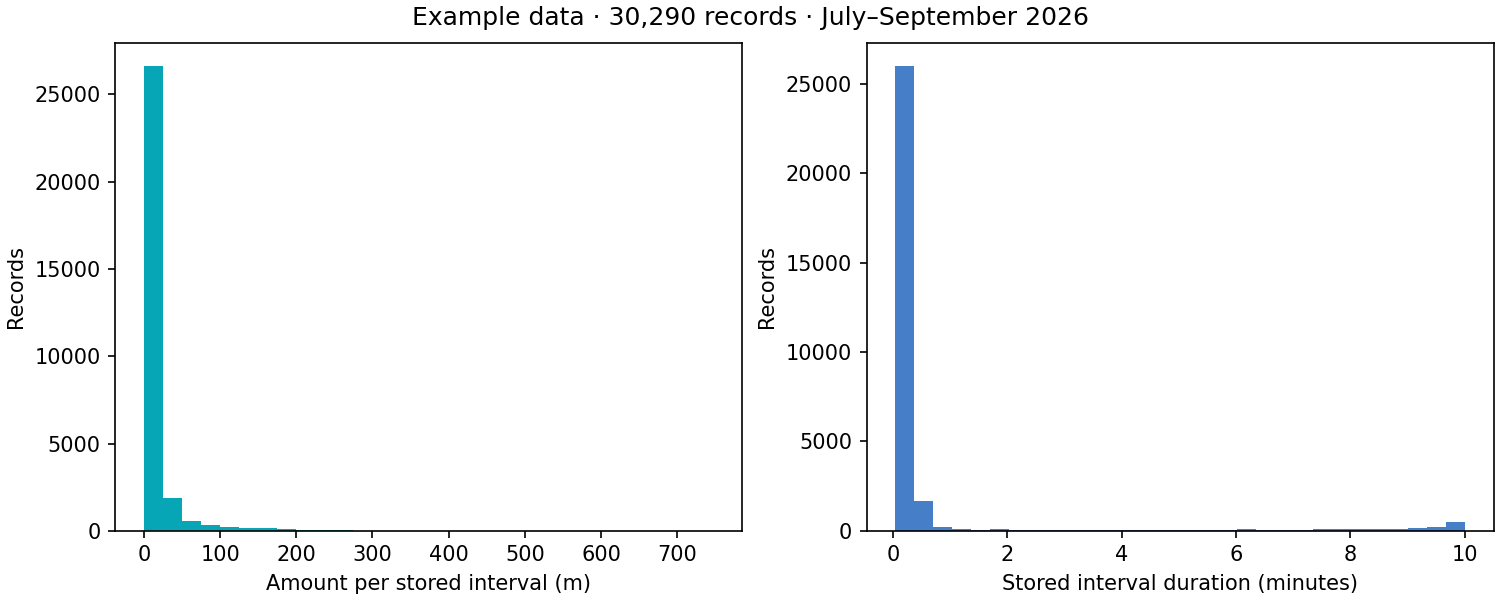
Walking + Running Distance: amounts and interval shape
Example July–September 2026 data from the source group with the most raw records in the focus window. Counts describe stored observations, not a recording-opportunity denominator or population norms.
View full-size figureHow this figure was made
Source selected by focus-window record count, grouping bundle identifier plus source display name and combining revisions. Half-open reporting window in America/Los_Angeles. Intervals selected by start; all retained observations plotted. Sources kept separate; no dates or source names shown.
How often is distance recorded?
Stored intervals varied from about 2.43 seconds to 10.01 minutes in the selected source. The median was 2.57 seconds. This mixture matters: a large distance accumulated over several minutes is not comparable to the amount in a brief interval without inspecting duration.
Interval duration is different from the gap between successive starts, and both differ from the device’s internal sensor sampling rate. Dense workout observations can dominate the sample count while representing a smaller share of the day. Missing intervals are not proof that no walking occurred.
Why can iPhone, Watch and Health totals differ?
Multiple source streams can record overlapping movement. Simply summing every raw interval can count the same journey more than once. Source-specific totals make this visible but do not reproduce Apple Health’s source-priority rules automatically.
Calibration also matters. Apple explains that calibration can improve distance and pace accuracy by learning stride length at different walking and running speeds. Apple’s calibration instructions describe the supported procedure. A changed source, route, pace or recording format can alter the series even if behavior is similar.
What changes during workouts and sleep?
The research kept workout-overlapping intervals separate from recorded-sleep overlaps and other or unknown intervals. An overlap does not attach the quantity explicitly to a workout: a stored interval may extend beyond it. Use the saved workout’s distance when that is the question, rather than treating all same-day distance as workout distance.
Sleep-overlapping movement needs a boundary and source check. It could occur around a sleep interval or reflect imperfect context records; it is not a measurement of distance traveled while asleep. The export also cannot prove awake rest when sleep data are absent.
How does distance relate to steps?
Selected-source daily raw distance sums and step counts were closely associated across 92 paired days (exploratory Spearman correlation 0.995). That does not create a fixed meters-per-step conversion: stride length changes with speed and activity, and the streams can share underlying estimation methods.
Inspect unusually high distance-per-time values as interval ratios, not a direct speed measurement. Short intervals, source overlaps, coalescing and boundary alignment can produce extreme ratios. Keep those records for review rather than silently discarding them.
Understanding your records
Recording frequency, source and coverage affect what you can conclude from this data. Read the recording guide.