
By PulsHealth. Updated
Real data exampleResearch reviewed . Figures use example Apple Health data.
What does running stride length measure?
Despite the name, Apple's running stride length means distance covered per single running step. The HealthKit definition and Apple Watch's running metrics guide use that convention. Do not double the recorded value or read it as a same-foot-to-same-foot gait cycle. A 1.01 m reading means about a metre of forward distance per step under Apple's definition.
What range appeared in the example data?
The July–September 2026 example contains 5,470 readings from one source group across 13 runs. These are observed values, not population reference ranges or training targets.
| Summary | Recorded value |
|---|---|
| Sample median | 1.01 m |
| Middle 90% of readings | 0.9–1.15 m |
| Full retained range | 0.83–1.57 m |
| Individual run medians | 0.97–1.34 m |
The histogram weights every stored reading equally, so longer or more densely recorded runs contribute more. The second panel gives each paired run one point. All extremes remain visible; an outlier flag is a reason to inspect its timestamps and context, rather than proof of an error or a clinical abnormality.
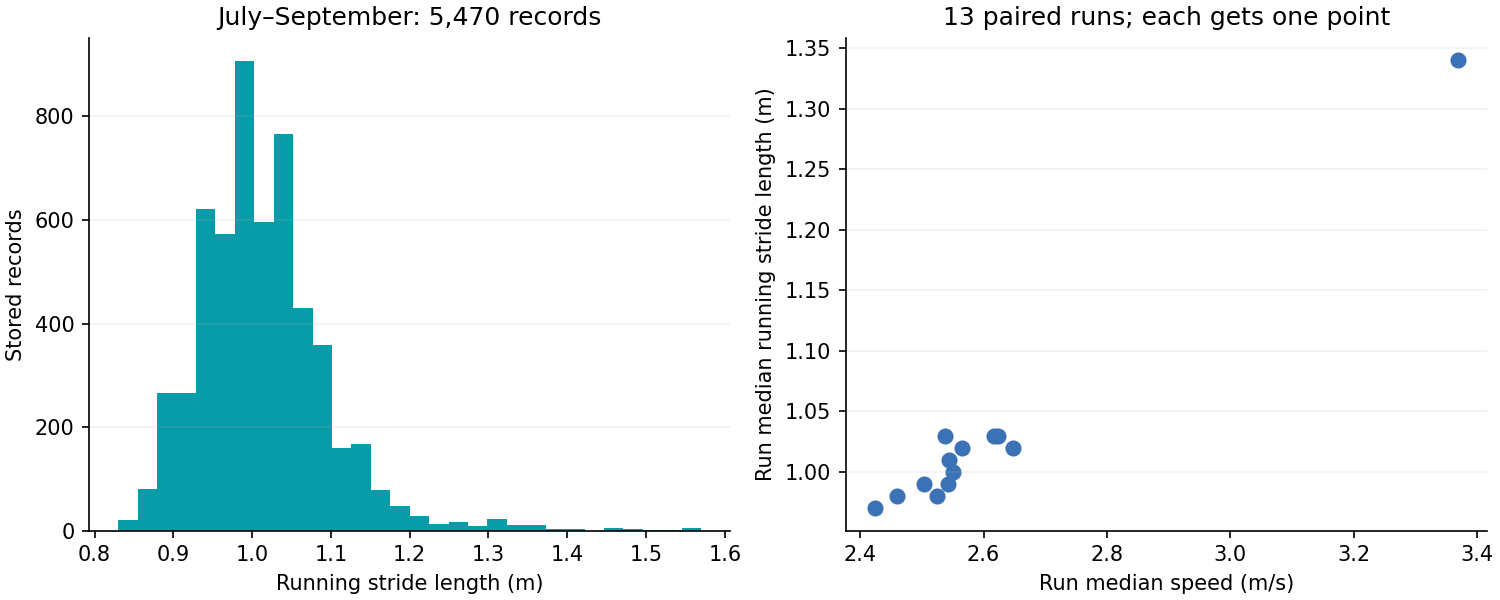
Stored readings and the differences between runs
Example July–September 2026 data: 5,470 readings from one source group on the left; 13 equally weighted run medians on the right. All recorded extremes are retained; these are not recommended ranges.
View full-size figureHow this figure was made
Raw quantities selected by local start date. Histogram weights each stored record; scatter uses same-source, fully contained readings within uniquely overlapping running workouts and one median per run. Workout series points are not pooled with raw records.
How often is it recorded?
The median positive gap between sample starts in this quarter was 5.13 seconds. This calculation includes gaps between runs; the mean would be dominated by those gaps. All quarter readings were point records with equal start and end timestamps. That is the stored shape, not proof that the sensors only operated once every 5.13 seconds.
Earlier months contained longer interval records. Apple documents that workout samples may be condensed or coalesced, so a change in sample counts or interval length is not automatically a change in training volume. Recording cadence is also different from running cadence in steps per minute.
How does it change through a run?
Stride length decreased by a median 0.08 m from the first to last elapsed-time third across 13 runs. The calculation compares medians of point readings in the first and last thirds of elapsed workout time, with at least five readings per third. Pace, terrain and pauses were not controlled. It cannot establish fatigue, fitness improvement or form breakdown.
Every quarter reading overlapped a recorded workout; none overlapped a recorded asleep interval. The example therefore supports comparisons within and between runs. A day without readings means no stored observation of this type, rather than a physiological zero.
Does a longer stride mean better form?
A longer recorded step is not automatically better. Compare speed and context first: a faster run can have longer steps without a deliberate technique change. In the 13 paired runs here, run-median stride length and speed had a Spearman association of 0.83. Ground contact time and vertical oscillation add timing and movement context; none diagnoses overstriding from stride length alone.
Keep the definition consistent when comparing devices or studies. In biomechanics, “stride” can describe a full gait cycle, whereas this Apple type uses a single-step distance. A comparison that silently mixes those definitions can be wrong by about a factor of two.
Speed divided by Apple's per-step length can form a rough step-frequency estimate only when observations are aligned and represent the same movement period. Dividing unrelated workout averages is not a measured running cadence; this article does not claim a cadence estimate from those ratios.
Technical reference and analysis limits
HKQuantityTypeIdentifierRunningStrideLength is a discrete quantity type, introduced in iOS 16/watchOS 9. Use averages, distributions or matched comparisons rather than summing readings. Automatic outdoor-running support is documented by Apple; the HealthKit reference names Apple Watch SE and Series 6 or later.
Raw quantity samples and workout-linked series are kept separate. This quarter contains 5,470 raw readings and 5,470 series points for this type; these counts are representations, not additional independent measurements to pool together. Source revision groups are provenance, not proof of a permanent device identity.
The research uses an October 2025–September 2026 extract with a July–September focus in America/Los_Angeles. Workout relationships use fully contained readings, the same source group and uniquely overlapping running workouts, with one median per run. Sleep and general workout context use timestamp overlap rather than explicit HealthKit associations. Context beginning before the extract boundary may be missing. The private executed notebook retains all eleven analysis facets, source changes, outlier checks and unsupported questions. Public figures omit dates, source names, identifiers and routes.
Understanding your records
Recording frequency, source and coverage affect what you can conclude from this data. Read the recording guide.