
By PulsHealth. Updated
Real data exampleResearch reviewed . Figures use example Apple Health data.
What does Walking Speed measure?
Walking Speed is the average speed estimated during a recorded interval of steady walking on flat ground. It is a measure of selected walking bouts, rather than an average over the whole day or a treadmill speed setting. Apple’s type documentation defines the measurement and recording conditions.
What do example records look like?
The reporting year contained 12,993 records on 365 of 365 days. July–September contained 2,871 records on 92 of 92 days, from one source group. Missing days remain missing rather than zero observations.
The focus-window median was 1.07 m/s, with the central 90% between 0.73 and 1.37 m/s. The full range was 0.45–2.19 m/s. For familiar units, 1 m/s equals 3.6 km/h. These observations describe example data, not a universal healthy walking speed or a clinical walking-test result.
| Reading question | Useful interpretation |
|---|---|
| What does one value summarize? | The stored walking interval, not every step that day |
| What does the range describe? | Recorded observations with each record given equal weight |
| What does a high or low tail mean? | A reason to inspect context and repeated values |
| How should a trend be compared? | Similar source, placement and walking conditions |
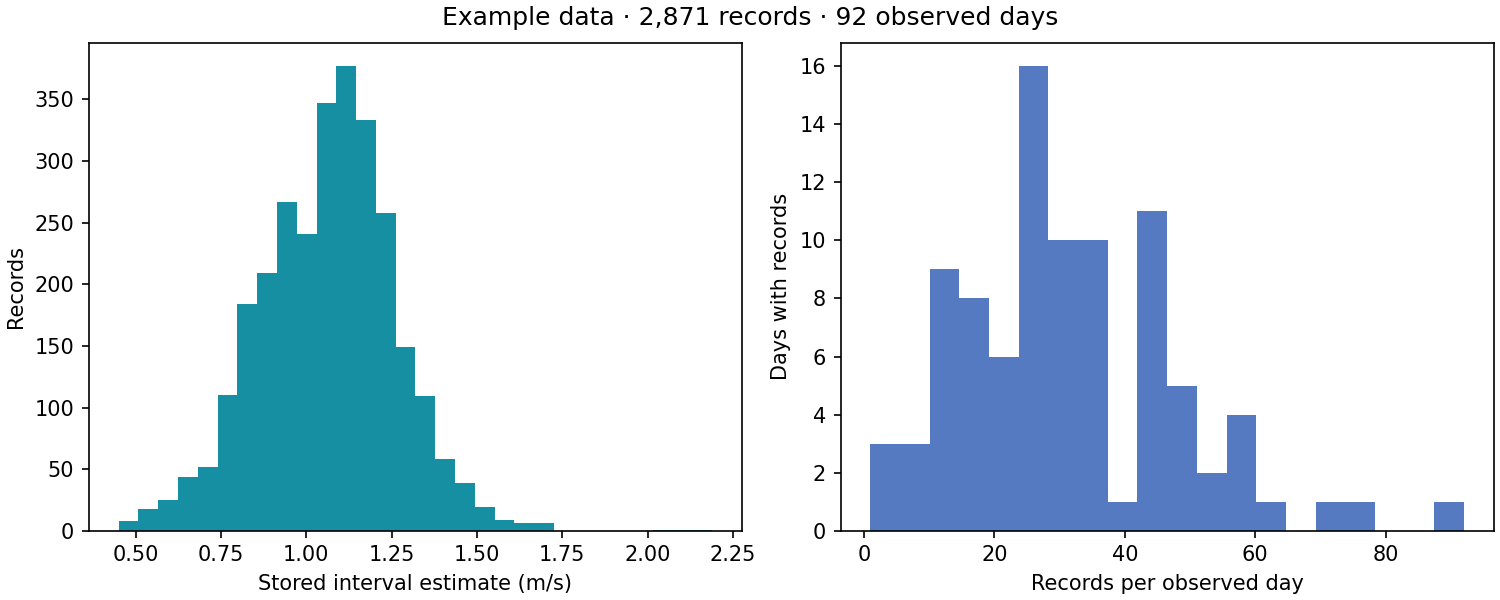
Walking Speed: values and daily recording counts
Example July–September 2026 data: 2,871 interval observations on 92 observed days. Left: each record has equal weight. Right: each observed day has equal weight; unrecorded days are excluded.
View full-size figureHow this figure was made
Source group selected by focus-window record count; bundle identifier plus source display name combines revisions. Half-open start-selected reporting window in America/Los_Angeles. All selected records retained; percent ratios multiplied by 100 where applicable. No source names or individual dates shown.
Why are records unevenly spaced?
In the focus window, observed-day recording counts ranged from 1 to 92, with a median of 29. Stored intervals had a median duration of 11.0 seconds and ranged from 1.7 to 300 seconds. The median positive start-to-start gap was 3.5 minutes; the largest was 23.4 hours.
Apple describes roughly 10–30 samples on a typical day. That is a recording description, not a guaranteed sampling schedule. The sensor’s internal measurements are not the same as exported sample timestamps. Each estimate can cover a different duration, so a simple record average and a duration-weighted average answer different questions.
How do workout records compare with other walking bouts?
Across the reporting year, 511 records overlapped stored workouts. Their median was 1.22 m/s, compared with 1.07 m/s outside recorded workouts and sleep. Within these separate context groups, median positive start-to-start gaps were 3.3 minutes for workout-overlapping records and 3.2 minutes for other records.
Those gaps include time between separate walking bouts and workouts; they do not measure a workout sensor frequency. Overlap is temporal, not proof of explicit workout linkage or that the entire walking interval occurred inside the workout. No walking records overlapped available recorded-asleep intervals in this snapshot.
How does this relate to other walking metrics?
Daily walking speed and step length moved together (Spearman 0.85 across 92 paired days). Speed also had an inverse association with double support (−0.71). These metrics describe related aspects of the selected walking pattern; none by itself establishes fitness, fall risk or a disease.
The analysis kept sources separate and compared reporting-day medians on days containing both types. It also checked unique exact interval matches and excluded ambiguous duplicate interval candidates. These are repeated observations in example user data, not independent participants, and the relationships do not show causation.
Walking speed, step length, double support and asymmetry each add a different view of gait. Walking Steadiness is a separate estimate, not a classification computed here from these charts.
What can change or prevent an estimate?
Automatic collection requires iPhone 8 or later, carried near the waist, during steady walking on flat ground. Apple says these samples are not recorded when wheelchair status is enabled. Phone placement and which walking bouts meet the algorithm’s criteria can therefore change the observed distribution without establishing a physiological change.
An up-to-date height in Health is required for accurate estimates. Compare persistent changes under similar conditions with how walking feels and functions. Consumer walking estimates do not replace a supervised gait assessment; a single extreme value should not be assigned a diagnosis.
Understanding your records
Recording frequency, source and coverage affect what you can conclude from this data. Read the recording guide.