
By PulsHealth. Updated
Real data exampleResearch reviewed . Figures use example Apple Health data.
What does cycling distance measure?
Cycling distance records how far you traveled by bicycle. HealthKit stores cumulative amounts: each sample contributes distance over its interval. A 20-meter sample is an interval amount, not a running odometer or a speed reading. PulsHealth stores meters; kilometers and miles are display conversions.
| Quantity | What it describes |
|---|---|
| Distance | Travel accumulated over an interval |
| Speed | Rate of travel |
| Power | Cycling output |
| Cadence | Pedal rotation rate |
How is it recorded outdoors and indoors?
Apple documents automatic distance recording during outdoor cycling workouts. Indoor workouts can record distance when the watch connects to a peripheral supplying cycling speed. Indoor distance can depend on equipment or simulation, so it should not automatically be equated with outdoor travel. Apple also notes that HealthKit may condense or coalesce workout samples.
What do example records look like?
The year-long investigation found 104,293 raw cycling-distance samples across two source groups, plus 286,166 separately stored workout-series points. Those streams were inspected separately rather than added together. The figure uses the source group with the most July–September records: 83,165 intervals across 30 observed days.
Observed-day raw sums ranged from 0.14 to 20.14 km, with a median of 18.47 km. Missing days were excluded, not treated as zero-distance days. Most stored intervals lasted about one second, but the longest lasted 113 seconds; a single fixed recording interval would miss that variation.
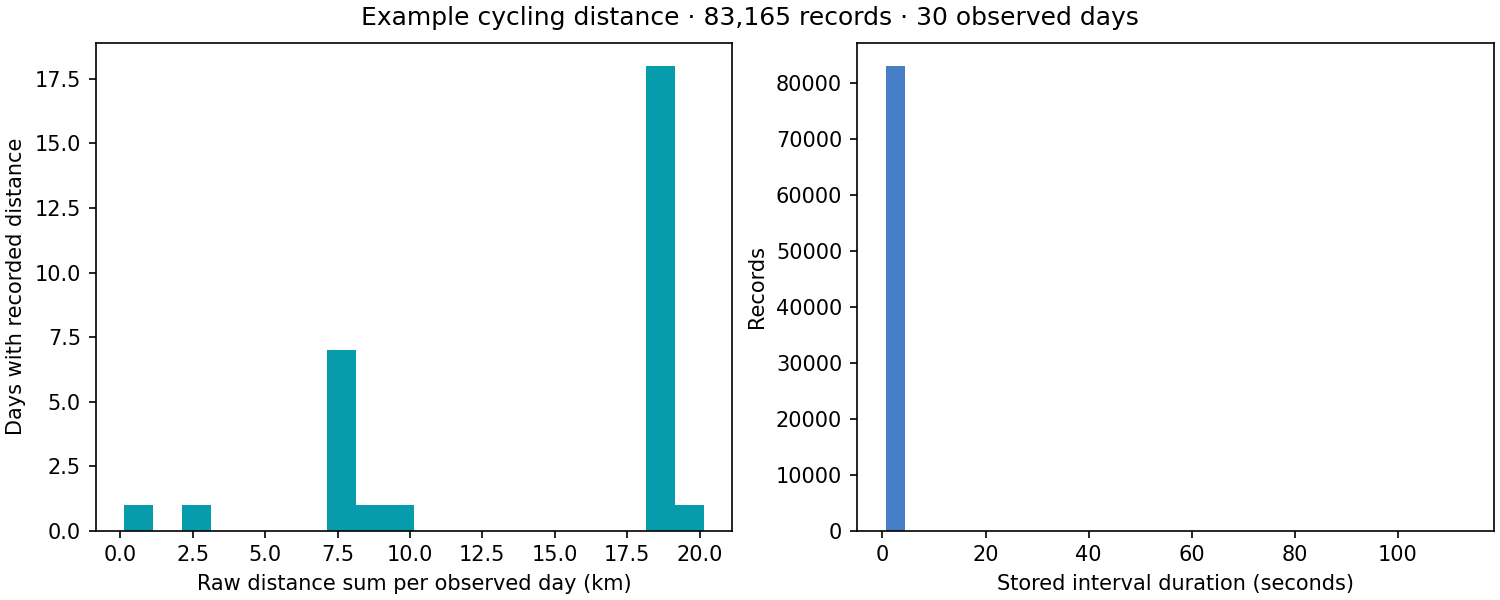
Cycling distance: day totals and recording intervals
Example July–September 2026 data, selected from the source group with the most focus-window raw samples. Thirty recorded days are weighted equally in the distance histogram; each stored interval is weighted equally in the duration histogram. Missing days are excluded.
View full-size figureHow this figure was made
Half-open America/Los_Angeles window, intervals selected by start. Raw cumulative distance summed within a single source on observed reporting days; no deduplication with other sources, no workout-series points added and no boundary prorating. Every retained duration shown. These sums do not reproduce Health source-priority totals.
Do larger samples mean faster cycling?
Not necessarily. The middle 90% of focus-window interval amounts ran from 0.21 to 7.48 meters, while the largest amount was 198.76 meters. The largest amount covered about 30 seconds rather than one second, illustrating how interval length can create an apparent amount outlier. Larger amounts can cover longer intervals. Inspect duration beside distance before labeling an amount a speed spike; dividing by duration produces an interval-average rate rather than an observed speed stream.
How closely do distance records align with workouts?
Of the 83,165 selected intervals, 83,016 overlapped a recorded workout and none overlapped recorded asleep intervals. Overlap is temporal context, not proof of explicit workout membership or a sensor-mode change. The 149 intervals outside recorded workouts do not establish that cycling stopped or that the records were wrong.
A gap is unknown recording coverage, not evidence of zero cycling or continuous watch wear.
Why can totals differ from Apple Health?
Multiple sources can record the same ride, and source priority affects summaries. Add cumulative amounts within a reviewed source; do not simply combine every source and the workout-series stream. Boundary-spanning intervals also complicate day totals. The plotted raw sums are analysis totals, not a claim to reproduce Apple's deduplicated daily display.
What other measurements help explain a ride?
Power, cadence and heart rate can supply effort context when supported and aligned to comparable intervals. This snapshot had no raw cycling-power, cadence, FTP or speed samples, so it could not establish their relationships with distance. Distance alone cannot identify intensity, sustainable power or pedal efficiency.
Understanding your records
Recording frequency, source and coverage affect what you can conclude from this data. Read the recording guide.