
By PulsHealth. Updated
Real data exampleResearch reviewed . Figures use example Apple Health data.
Is basal energy a measurement of metabolism?
Basal Energy Burned stores the estimated resting energy used for basic functions such as breathing and circulation. In Apple Health, it complements Active Energy. It continues accumulating while activity occurs; it is not restricted to timestamps when the user is motionless.
Apple defines this as a cumulative energy quantity. A sample is an amount over an interval, in kcal or kJ. It is not a direct clinical basal metabolic rate test, and a small sample does not mean that the body used only a fraction of a calorie that day.
| Question | Appropriate evidence |
|---|---|
| How much resting energy was recorded today? | A complete, calendar-aligned cumulative total |
| Why is this sample larger? | Its interval duration and source |
| Did my metabolism change? | Consistent coverage and profile history; a wearable estimate alone cannot establish this |
| What is total estimated expenditure? | Active and resting estimates for matching periods, avoiding duplicate sources |
What do real interval values look like?
The selected Apple-health source supplied 71,518 intervals across all 92 July–September days. Raw values ranged from 0.095 to 89.225 kcal, with a median of only 0.096 kcal. The small median reflects the many short intervals saved during workouts, rather than a daily resting-energy requirement.
Assigning full interval amounts to their start day gave a median selected-source sum of 2,421 kcal/day, with observed sums from 1,372 to 2,600 kcal/day. These are example source sums, not a reference range. Overlapping intervals, missed coverage and cross-midnight allocation mean they should not be treated as an exact reconstruction of the Health app's total.
The largest selected-source amounts, 89.225 kcal, each covered one hour; the smallest 0.095-kcal examples covered about 2.57 seconds. Their very different amounts are explained largely by interval length.
Does recording change during workouts or sleep?
Yes, the representation changes substantially in the example data. Workout-overlap intervals had a median length of 2.57 seconds; other or unknown intervals had a median of 30.8 seconds. Intervals overlapping recorded sleep had a median length of one hour. Apple notes that resting-energy samples may be condensed or coalesced.
The figure converts interval amounts to average rates. It includes 57,024 workout-overlap intervals on 49 days, 13,620 other or unknown intervals on 92 days, and 874 sleep-overlap intervals on 92 days. These groups differ in both recording granularity and context. Each interval has equal weight; they do not represent equally long stretches of the day.
Median stored interval-average rates were about 2.25 kcal/min for workout overlap and 1.48 kcal/min for sleep overlap. This does not establish an acute change in basal metabolism. The database lacks an independent metabolic measurement, and long intervals can extend beyond the sleep periods they overlap. Other or unknown does not mean confirmed rest or wakefulness.
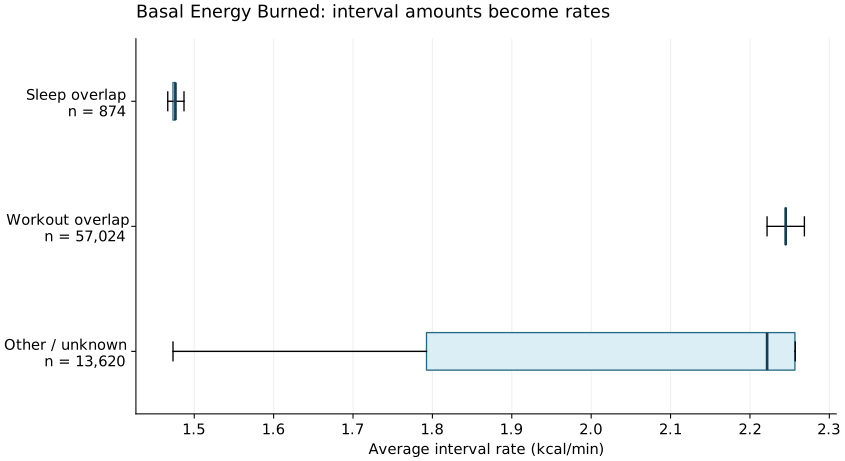
Recording context changes interval-average energy rates
Selected-source example data: 57,024 workout-overlap intervals on 49 days, 13,620 other or unknown intervals on 92 days, and 874 sleep-overlap intervals on 92 days. Differences mix estimation and interval representation; this is not an independently measured metabolic response.
View full-size figureHow this figure was made
July–September 2026, fixed America/Los_Angeles reporting calendar. Largest Apple-health source group by record count, bundle/name grouping across source revisions. Amount divided by positive duration of at least one second. Boxes span p25–p75 with median; whiskers p5–p95. Extreme intervals retained in analysis but omitted from this display. Each interval weighted equally. Half-open overlap with workouts and asleep categories 1/3/4/5; other/unknown is not confirmed rest or wakefulness.
Why might the estimate change over time?
Profile information and recording history matter. Apple says height, weight, gender and age influence calorie calculations. A changed profile, source, interval representation or completeness can move a stored estimate without establishing a physiological change. The exact resting-energy formula cannot be identified from these records.
Three source groups contributed resting-energy records in the year, and within-source overlaps were found. Source revisions are not stable device identifiers. When a chart changes abruptly, check sources and interval lengths before inferring a metabolic explanation. Review unusually high amounts beside their durations: an hour-long estimate should not be compared directly with a two-second sample.
What can basal energy be compared with?
Combine resting and active energy only for matching periods with coherent source handling. Do not add a separate generic allowance for digestion and call the result a validated total: HealthKit's named estimates alone do not establish how every component of expenditure was modeled.
The selected-source daily resting sums had an exploratory rank correlation of 0.33 with active-energy sums across 365 paired days, and 0.10 with Exercise-time sums across 352 days. Shared recording and estimation inputs can produce relationships; these comparisons cannot identify causality or predict an individual's calorie needs.
Body Mass can provide context for profile updates, but a change in a wearable resting estimate does not diagnose thyroid disease, metabolic adaptation or body composition. A database export also cannot verify calorie balance from incomplete food-energy logs. Keep missing data separate from zero and compare periods with similar coverage.
Understanding your records
Recording frequency, source and coverage affect what you can conclude from this data. Read the recording guide.