
By PulsHealth. Updated
Real data exampleResearch reviewed . Figures use example Apple Health data.
What counts as an Exercise minute?
Apple Exercise Time is the cumulative time credited to the green Exercise ring. Apple describes it as full minutes of movement at or above the intensity of a brisk walk. It can accumulate outside a recorded workout.
Apple's measurement guidance explains that cardio fitness helps determine what is brisk for the user, with brisk pushes used for wheelchair users. Lower-intensity movement can contribute to Move credit without earning Exercise credit. There is no universal walking-speed or heart-rate threshold that explains every user's ring.
| Metric | What it counts |
|---|---|
| Exercise Time | Credited qualifying minutes |
| Workout elapsed time | Time between workout start and end, including possible pauses |
| Active Energy | Estimated calories above resting expenditure |
| Activity Summary | Recorded daily ring totals and goals |
How frequently are minutes saved?
In the July–September example, the selected source recorded 3,191 samples on 89 of 92 days. Every selected sample contained one minute and spanned 60 seconds. This is a useful recording pattern, not a promise that every source or operating-system version uses it.
The selected-source recorded-day totals had a median of 29 minutes and ranged from 1 to 142 minutes. The three days without selected-source records were left missing, rather than assigned zero. One-minute values are not physiological measurements repeated every minute; gaps indicate intervals without a recorded Exercise sample from this source.
Why doesn't Exercise Time equal workout duration?
The Workout app uses additional inputs such as heart rate and GPS. Starting a workout changes the recording context, but elapsed time and qualifying Exercise credit remain different concepts. Some qualifying movement occurs outside workouts, while pauses or activity that does not qualify can make credited minutes lower than workout elapsed time.
In the focus window, 2,469 selected-source samples overlapped workouts on 48 days, and 722 samples belonged to other or unknown context on 87 days. Workout overlap does not prove that each sample was explicitly associated with that workout. The figure compares source-selected daily Exercise sums with elapsed workout time on days where both were available; the points need not lie on the equal-minutes line.
Across the full year, selected-source Exercise sums and workout elapsed minutes were paired on 190 days. Their difference ranged from about 46 minutes less to 40 minutes more. That range describes recorded totals, not the accuracy of the watch: workout elapsed time is not a reference measurement of qualifying intensity, and duplicate workouts or pauses can also matter.
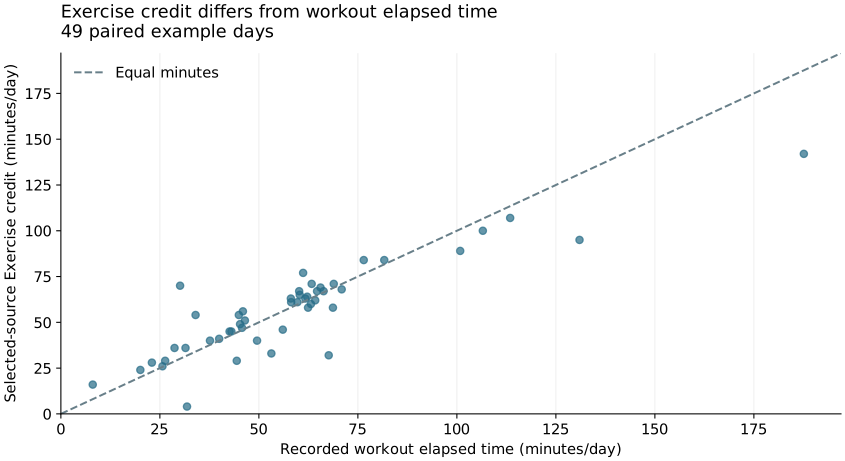
Exercise credit and workout elapsed time
49 paired example days: Example daily Exercise credit and recorded workout elapsed time, paired only where both exist in the focus window. Credit outside workouts, qualifying intensity, pauses, overlap and source handling can move a point away from equal minutes. Workout time is not ground truth for Exercise credit.
View full-size figureHow this figure was made
July–September 2026, fixed America/Los_Angeles reporting calendar. Largest Apple-health source group by record count, bundle/name grouping across source revisions. Full interval amounts assigned to start day; recorded workout elapsed durations summed by start day. Only paired days plotted; neither series is reconstructed from the other.
What happens during recorded sleep?
No selected-source Exercise samples overlapped recorded asleep intervals in the focus window. This is a statement about available records, not a measured overnight zero rate or evidence that all sleep was captured. Other or unknown context is not proof of wakefulness.
If an Exercise minute appears near sleep, inspect the interval boundaries, the contributing source and the sleep record before inferring an overnight activity. A sleep annotation and an Exercise interval can overlap because of timestamp or classification differences.
Why can raw samples differ from the green ring?
Three source groups contributed Exercise samples in the year. The selected group had some overlapping intervals, and its start-day sums matched recorded daily ring totals within 0.01 minute on 287 of 352 paired dates. Those summaries use recorded phone-local dates; the analysis uses a fixed reporting calendar. The mismatch alone does not establish a tracking error.
Use Activity Summary when the question concerns the ring, and keep source/calendar filters when using HealthKit daily statistics. Avoid adding workout duration to Exercise samples: they describe overlapping activity rather than independent time credits.
How should trends and unusual totals be read?
A low recorded total can reflect less qualifying movement, incomplete recording or a change in detection. A high total can reflect sustained activity or duplicate source handling. Neither number diagnoses motivation, overtraining or exercise quality. Check coverage, intervals and sources before interpreting a change; the one-minute samples in this example have a constant value, so numeric sample-value outlier rules are uninformative.
Exercise Time and Active Energy had an exploratory daily-sum rank correlation of 0.88 across 352 paired days. They share activity inputs, so the relationship does not supply a calorie-per-minute conversion. Cardio Fitness measures a different concept, and ring credit alone does not describe intensity distribution, resistance training, or the full mix of physical activity.
Understanding your records
Recording frequency, source and coverage affect what you can conclude from this data. Read the recording guide.