
By PulsHealth. Updated
Real data exampleResearch reviewed . Figures use example Apple Health data.
What does Apple Stand Time measure?
Apple Stand Time is a cumulative duration in minutes. It describes recorded standing time, rather than the number of hours credited to the blue Stand ring. Apple documents this as a time quantity; the exact sensing algorithm is not a public specification. Apple’s type documentation establishes the unit and cumulative semantics.
| Metric | Stored meaning | Useful summary |
|---|---|---|
| Stand Time | Minutes accumulated within an interval | Source-aware sum of minutes |
| Stand Hour | Stood or idle category for an hourly interval | Count qualifying hours after handling overlap |
| Stand ring | Daily Activity summary | Recorded daily progress and goal |
Twelve credited stand hours do not mean twelve hours spent standing. The ring credits standing and moving for at least a minute within an hour. Apple’s activity guide explains that behavior; it is a ring rule, not a clinical prescription.
What do example intervals look like?
The reporting year contained 23,622 records on all 365 days. In July–September, the source group with the most records contributed 4,553 entries across 92 days. Every interval was five minutes long, while the amount inside it ranged from one to five minutes. No selected-source interval contained more recorded stand minutes than its duration.
The selected source’s daily raw sums ranged from 3 to 233 minutes, with a median of 121.5 minutes. These are recorded amounts for that source, assigned to the reporting date of the interval’s start. They are examples, not recommended daily targets or complete measurements of posture.
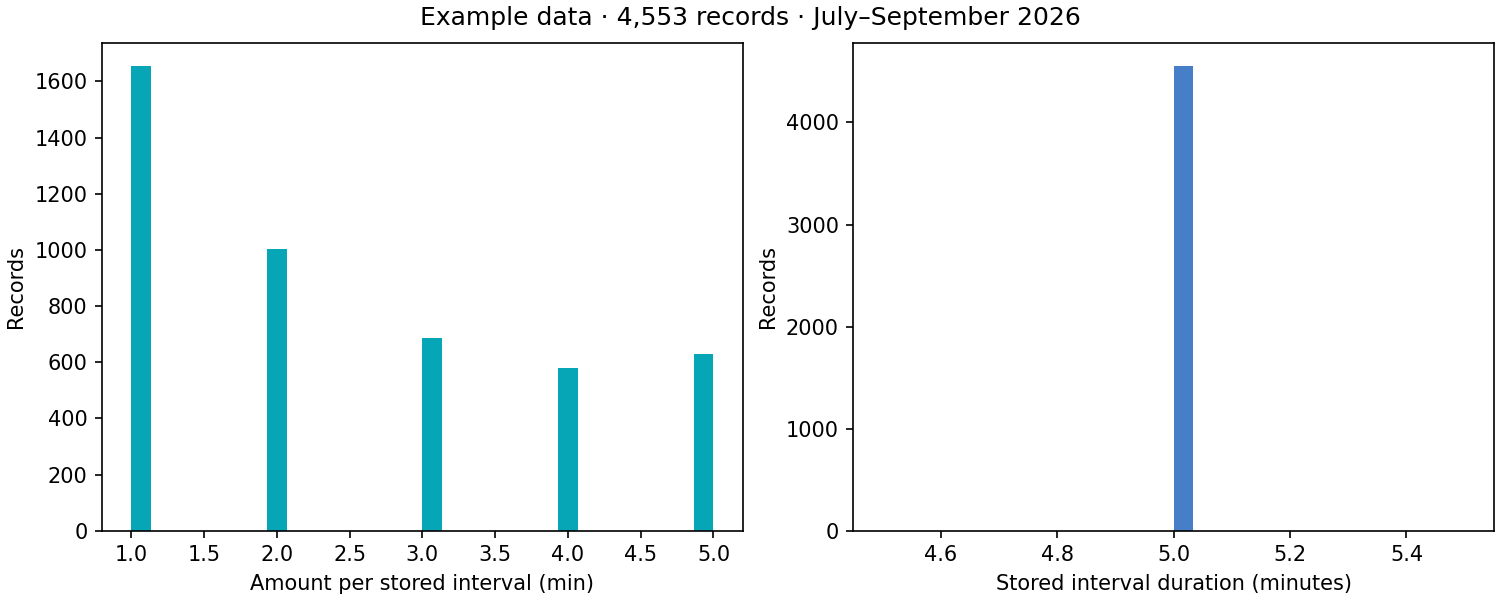
Apple Stand Time: amounts and interval shape
Example July–September 2026 data from the source group with the most raw records in the focus window. Counts describe stored observations, not a recording-opportunity denominator or population norms.
View full-size figureHow this figure was made
Source selected by focus-window record count, grouping bundle identifier plus source display name and combining revisions. Half-open reporting window in America/Los_Angeles. Intervals selected by start; all retained observations plotted. Sources kept separate; no dates or source names shown.
How often are records stored?
Five-minute intervals describe the storage shape, not a promise of a record every five minutes. There can be gaps between intervals, and different sources can overlap. A gap does not identify sitting, charging, non-wear or a permission problem by itself.
Do not replace an interval’s recorded amount with its full duration. A five-minute interval containing two stand minutes contributes two minutes to a raw sum, not five. Start-assigned daily summaries also need boundary checks: an interval ending at midnight and one crossing midnight require different treatment.
What changes during workouts and sleep?
The year’s source-aware investigation found stand-time intervals overlapping both workouts and recorded sleep. Temporal overlap is a context flag: a five-minute interval touching a sleep episode can include time outside that episode. It does not establish that standing occurred while asleep, or that the sleep classification was wrong.
Compare sources and interval lengths before interpreting workout changes. Continuous movement can produce more recorded minutes within an interval, while a long quiet gap changes the sampling opportunities. Sample averages and daily totals answer different questions.
How does this relate to steps and Stand Hours?
Source-paired daily raw sums were compared with steps and walking/running distance. For the selected source, stand minutes and steps rose together across the 92 observed days (exploratory Spearman correlation 0.71). This association describes recording patterns; it does not establish benefit, causation or independence from watch wear.
Stand Hour preserves the distribution of threshold successes across the day. Step Count describes walking volume. Neither can reconstruct all standing duration from the other.
How should missing or unusually high values be handled?
Keep sources separate before adding cumulative amounts. A raw sum across simultaneous streams can count overlapping movement twice, and may differ from the Health app’s chosen-source total. A very high daily value deserves an interval, source and boundary review before an activity interpretation. A low total may reflect incomplete recording; it is not a diagnosis of sedentary behavior.
Stand Time is useful for tracking recorded movement patterns over comparable days. It cannot determine posture quality, sitting duration, metabolic effects or the suitability of a standing desk for an individual.
Understanding your records
Recording frequency, source and coverage affect what you can conclude from this data. Read the recording guide.