
By PulsHealth. Updated
Real data exampleResearch reviewed . Figures use example Apple Health data.
Is sleeping wrist temperature absolute or a baseline change?
HealthKit stores an absolute overnight wrist temperature. Apple Health displays changes relative to a personal baseline. These are different representations of the same feature. Apple’s developer documentation explicitly distinguishes them.
A stored value near 36°C is wrist skin temperature. It is neither a +36°C baseline change nor a thermometer measurement of core temperature. Do not compare absolute wrist values directly with oral fever thresholds or subtract an arbitrary population baseline.
What do example records look like?
October 2025–September 2026 contains 22 records on 22 of 365 reporting days, from one source group. Only two records fall in the 92-day July–September focus window. The full-year figure is used because that short window cannot support a meaningful distribution or trend.
| Full-year observation | Example value |
|---|---|
| Median absolute wrist temperature | 35.90°C |
| Full observed range | 35.61–36.13°C |
| Median stored interval duration | 8.77 hours |
| Median positive start-to-start gap | 6.90 days |
Those gaps show sparse availability in this database, not the feature’s intended nightly schedule. None of the 22 values was missing, zero or negative. Extremes were retained; this small observed range is not a normal range for other users.
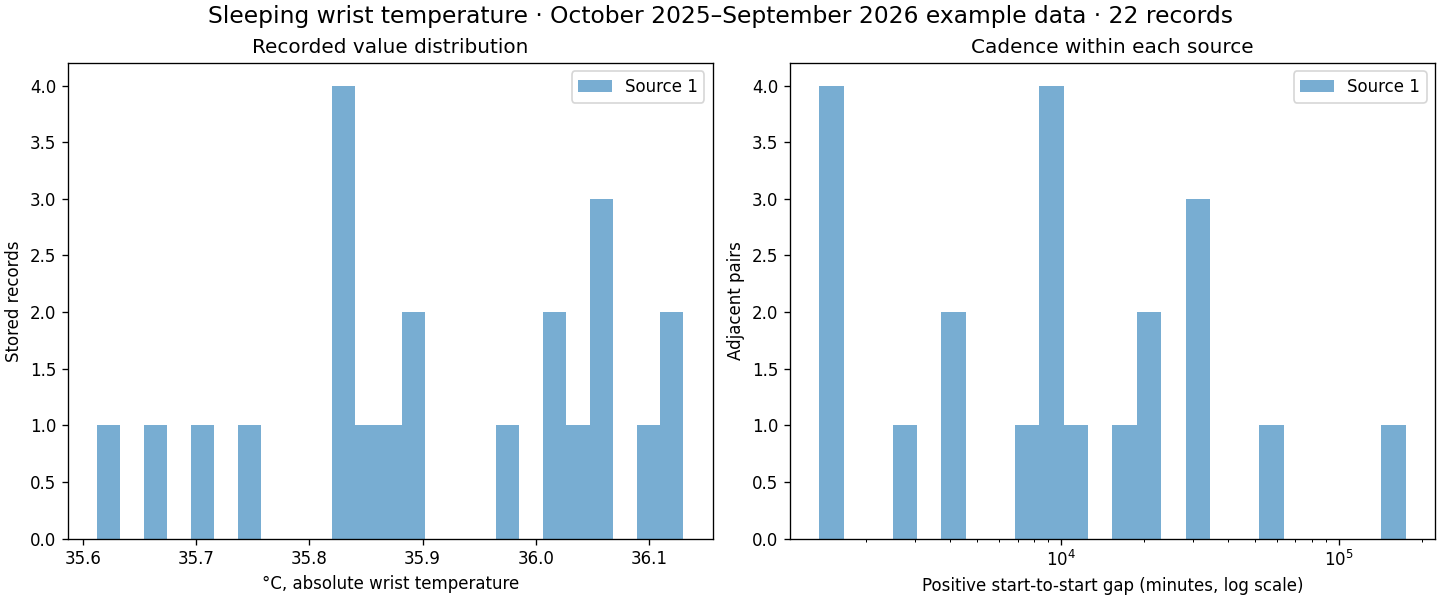
Recorded values and source-specific cadence
22 example records, October 2025–September 2026. Source streams remain separate; gaps include unrecorded periods. Absolute wrist skin temperature, not baseline changes.
View full-size figureHow this figure was made
Start-selected observations in the fixed reporting calendar. All finite values retained; gaps computed only between adjacent starts within each source group. Source groups combine bundle and display name and do not prove persistent device identity. No timestamps, names or identifiers are published.
Why is a record several hours long?
Apple describes internal sensing every five seconds, but HealthKit exposes an aggregated overnight sample, not the raw five-second stream. The stored intervals in this example span 6.46–10.56 hours. Interval duration does not prove uninterrupted sensing or the number of internal successful readings.
Both focus-window records overlapped recorded asleep intervals; neither overlapped a workout. With two observations, there is no useful estimate of within-night cadence, exercise response or sleep-stage differences. A nightly interval overlapping multiple stages does not supply a separate temperature measurement for each stage.
When does the feature start showing a baseline?
Apple’s setup guidance requires supported hardware, sleep tracking and Sleep Focus. About five nights with Sleep Focus for at least four hours nightly establishes the displayed baseline. Supported devices currently include Series 8 and later, Ultra models and SE 3; eligibility and requirements can change.
HealthKit absolute samples can be available before Health’s baseline display appears. The baseline algorithm is not reconstructed by this analysis. Missing nights cannot distinguish watch fit, settings, permissions, wear, sync completeness or measurement eligibility.
What can a change tell you?
Exercise, alcohol, environment, illness and menstrual cycles may affect overnight temperature. Apple uses temperature in retrospective ovulation estimates and cycle tracking, but the feature is not an on-demand thermometer or a medical diagnostic measurement. Avoid diagnosing fever, pregnancy, infection or ovulation from an isolated value.
The research checked source-paired daily relationships to respiratory rate and oxygen saturation. Sparse temperature coverage and mixed context prevent a reliable account of physiological response. There were no ordinary Body Temperature records to validate a wrist-to-thermometer relationship.
How should trends be summarized?
Keep source revisions and overnight intervals visible. Compare consistent-source nights and state how many nights are present. Use the Health UI baseline change only when that representation is actually available; a custom mean-centered series should be labelled as an analyst-derived change, not Apple’s baseline. Never sum temperatures or fill missing nights with zero.
Understanding your records
Recording frequency, source and coverage affect what you can conclude from this data. Read the recording guide.