
By PulsHealth. Updated
Real data exampleResearch reviewed . Figures use example Apple Health data.
What does swimming stroke count measure?
This quantity adds up recorded swimming strokes over an interval. It uses count units and cumulative aggregation, so a large sample can reflect more swimming rather than a faster stroke rate. Apple defines the quantity without establishing a universal target count or a guaranteed per-lap recording interval.
What do example records look like?
The example data contained 51 stroke-count intervals on one May recording day, all from one source group. Counts ranged from 7 to 17 per interval, with a median of 11 and a raw total of 572. All were finite, positive integers; duplicate UUID and identical-content checks found no candidates. These values describe this recording, not beginner, advanced or elite technique thresholds.
| Measured feature | Example result |
|---|---|
| Strokes per stored interval | 7–17; median 11 |
| Duration represented by an interval | 14.25–46.01 seconds; median 28.10 |
| Start-to-start recording interval | 16.79–136.15 seconds; median 29.71 |
| Exact same-source distance matches | 51 of 51 |
| Recorded workout/sleep overlap | All 51 overlap a swim workout; none overlap sleep |
The figure shows changing counts beside interval durations. A higher count does not by itself indicate fatigue: interval duration, stroke style, swimming speed and rest can also change. The observed start gaps are the cadence of stored intervals, not a measurement of how often the wrist sensor sampled movement.
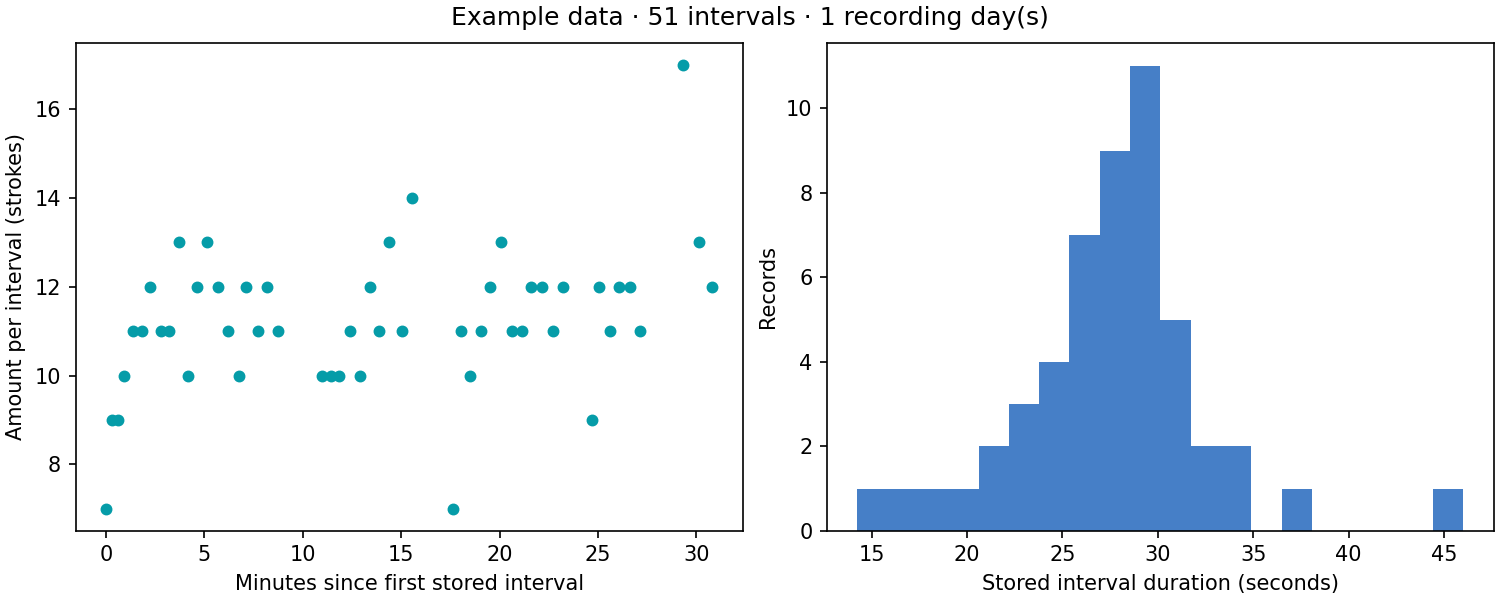
Swimming Stroke Count: interval amounts and timing
Example data: 51 intervals from one source group on one recording day in May 2026. Every retained annual observation is plotted; no records occurred in the July–September focus window.
View full-size figureHow this figure was made
Half-open October 2025–October 2026 window in America/Los_Angeles, selected by sample start. Source group uses bundle identifier plus display name, combining revisions. Amounts shown against minutes since the first recorded interval; histogram counts stored interval durations. No source names, absolute timestamps or identifiers displayed. No inferred lap membership or fabricated observations.
How does stroke count relate to swimming distance?
Each stroke interval had one exact same-source timestamp match to a distance interval of approximately 22.86 m. Among those positive pairs, distance divided by recorded strokes ranged from 1.34 to 3.27 m per stroke, with a median of 2.08. Matching was restricted to unique exact intervals; no ambiguous interval pairs required exclusion.
That ratio is useful for exploring the data, but it is not a validated efficiency score. Comparisons should keep distance, timing, stroke convention, stroke style, pool length and source consistent. Fewer strokes can accompany a longer glide or slower swimming, so count alone cannot establish improvement.
Can these records produce SWOLF or a lap-by-lap assessment?
The overlapping swim workout retained a length setting of 22.86 m, but no lap events or detailed statistics were exported. The analysis therefore did not assign lap membership or calculate SWOLF. A same-time distance match supplies a denominator for a descriptive ratio; it does not replace verified lap timing.
Stroke-style metadata was present on all 51 count samples, with the same raw code throughout. Apple's documented stroke-style enumeration includes unknown and mixed values as well as individual strokes and kickboard. Avoid invented numeric labels: retain the original value and decode against the actual enumeration. Apple documents stroke-style values and the metadata's lap-event scope.
What do gaps and outliers mean?
The maximum gap after a stored interval was 109.55 seconds. Two adjacent gaps were slightly negative by less than 0.0002 seconds, consistent with a boundary precision issue rather than evidence of simultaneous swimming. Long gaps may reflect rest or missing recording; neither cause is established by the timestamps alone.
Only one recording day occurred in the October 2025–September 2026 research window, and there were no observations in the July–September focus window. Habitual cadence, fatigue trends and training adaptation are unavailable. Heart rate or energy can add workout context when coverage is aligned, but stroke count does not determine either quantity.
Which technical details matter?
Keep interval counts separate from total-workout counts and preserve the source's counting convention. Summing overlapping streams can double-count activity. Missing records are not zero-stroke swimming. Apple Watch's swimming summary can provide sets, rests and stroke information, but those user-interface features do not guarantee that every exported quantity row carries lap details. Apple's swim guide describes the workout summaries.
Understanding your records
Recording frequency, source and coverage affect what you can conclude from this data. Read the recording guide.