
By PulsHealth. Updated
Real data exampleResearch reviewed . Figures use example Apple Health data.
What does swimming distance measure?
Swimming distance is the amount traveled through the water, stored as a cumulative length quantity in metres. A sample contributes distance over its recorded interval; it is not an instantaneous speed reading. Apple's definition specifies length units and cumulative aggregation.
Why does pool length matter?
For an Apple Watch Pool Swim workout, enter the pool length before starting. The workout summary tracks distance, sets and rest periods. A wrong length setting can distort the distance attributed to completed lengths. Open Water Swim is a separate workout choice, so keep the recording mode with the distance rather than assuming all swims have a pool-length denominator. Apple's swimming guide explains setup and summaries.
| Context | Check before comparing |
|---|---|
| Pool swim | Configured length, completed lengths and rests |
| Open water | Recording mode, route coverage where available and interruptions |
| Multiple apps | Sources and overlapping sample intervals |
| Pace estimate | Distance, elapsed versus moving time and comparable boundaries |
What do example records look like?
One recording day in May contributed 51 distance intervals from one source group. Every interval held approximately 22.86 m, matching a 22.86 m length setting retained on the overlapping workout. The raw source sum was approximately 1,165.86 m. Repeated equal amounts illustrate how a distance stream can be organized around a configured length rather than continuously changing distance increments.
| Measured feature | Example result |
|---|---|
| Distance per stored interval | 22.86 m throughout |
| Interval duration | 14.25–46.01 seconds; median 28.10 |
| Start-to-start interval | 16.79–136.15 seconds; median 29.71 |
| Gap after an interval | Median 2.65 seconds; maximum 109.55 |
| Workout/sleep overlap | 51 intervals overlap a swim workout; none overlap recorded sleep |
Two adjacent gaps were slightly negative, by less than 0.0002 seconds, showing that exported timestamp precision matters when auditing boundaries. All values were finite and positive; no duplicate UUIDs or identical-content candidates were found. These are checks on the example, not proof that every length was captured correctly.
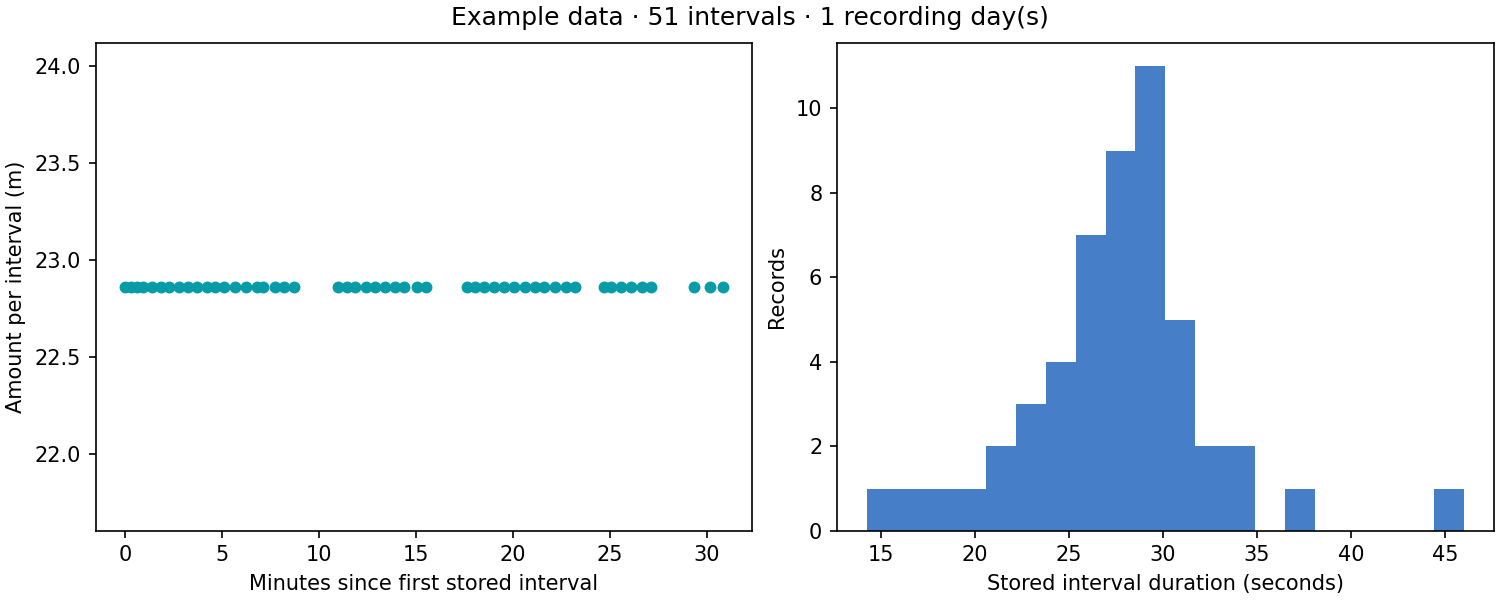
Swimming Distance: interval amounts and timing
Example data: 51 intervals from one source group on one recording day in May 2026. Every retained annual observation is plotted; no records occurred in the July–September focus window.
View full-size figureHow this figure was made
Half-open October 2025–October 2026 window in America/Los_Angeles, selected by sample start. Source group uses bundle identifier plus display name, combining revisions. Amounts shown against minutes since the first recorded interval; histogram counts stored interval durations. No source names, absolute timestamps or identifiers displayed. No inferred lap membership or fabricated observations.
Can distance be matched to strokes or used for SWOLF?
All 51 intervals had one exact same-source timestamp match to a swimming stroke-count interval. For positive matched pairs, metres per recorded stroke ranged from 1.34 to 3.27, with a median of 2.08. This is a descriptive ratio of the stored quantities. It does not confirm an explicit HealthKit lap association or establish a technique rating.
No workout lap events or detailed workout statistics were present in the export. SWOLF and verified lap pace were therefore not calculated. The workout's location metadata was exported as a Boolean rather than a numeric location code; it was not decoded into a pool/open-water label. Constant distances and a configured length are useful clues, but do not repair missing event membership.
What can this example tell us about longer-term patterns?
The full October 2025–September 2026 window contained only this recording day, with no swimming distance in the July–September focus window. It cannot establish training progression, habitual cadence or a population range. Across future sessions, compare like recording modes and source coverage, and distinguish raw sums from the totals Apple Health shows after source prioritization.
Which technical details matter?
Apple's lap-length metadata is a length quantity that can appear on a workout, segment or distance sample; its placement is not guaranteed on every row. The metadata documentation explains its scope. Keep source provenance, raw interval boundaries and original units before estimating pace or matching to strokes. A long gap may include a rest or missing recording; the gap alone cannot distinguish them.
Understanding your records
Recording frequency, source and coverage affect what you can conclude from this data. Read the recording guide.