
By PulsHealth. Updated
Real data exampleResearch reviewed . Figures use example Apple Health data.
What does Physical Effort mean in Apple Health?
Physical Effort is an estimated metabolic intensity, expressed in METs. The stored unit here is kcal/(kg*hr). Apple defines it as a discrete estimate of task energy demand, excluding factors such as temperature, altitude or heart rate. Apple Watch records it automatically.
It is not a subjective rating of perceived exertion, the workout effort score shown elsewhere in Fitness, or mechanical power in watts. A 6-MET observation is an intensity estimate, rather than six calories burned or a six-out-of-ten difficulty rating.
| Quantity | Unit | How to summarize |
|---|---|---|
| Physical Effort | METs, stored as kcal/(kg*hr) | Compare distributions within a source and context |
| Active Energy | kcal over an interval | Use source-aware cumulative totals |
| Running or Cycling Power | W | Mechanical power estimate or measurement with its own source |
| Heart Rate | beats/min | Physiological response with separate recording coverage |
What ranges appeared in the example data?
The year contained 184,189 records. The largest source group contributed 38,523 records across all 92 July–September focus days. Within that group the observed interval values spanned 1–20 METs, with a median of 3.9 and a middle half from 2.1 to 5.1. These describe the example's recorded estimates; they are not clinical limits or a recommended intensity range.
The upper observed value of 20 should not be treated as a physiological maximum. Retain unusually high estimates and inspect their duration, activity metadata and neighboring records before deciding whether they reflect activity or a recording problem. No laboratory metabolic measurements were available to validate these estimates.
What changes during workouts and recorded sleep?
| Overlap context | Records | Days | Median METs | Median interval duration |
|---|---|---|---|---|
| Workout | 7,553 | 48 | 6.8 | 12.8 s |
| Other or unknown | 30,927 | 92 | 3.5 | 15.4 s |
| Recorded sleep | 43 | 8 | 1.0 | About 60 min |
Workout-overlap estimates were higher in this source, but the comparison weights every stored record equally. Dense recording makes workouts contribute more observations. Context is assigned by time overlap, rather than an explicit HealthKit workout link, and other or unknown does not mean confirmed rest.
Only 43 intervals overlapped recorded sleep, on eight days. Their long durations can span multiple sleep stages or a boundary. This limited evidence cannot establish a typical overnight cadence or validate a resting metabolic rate.
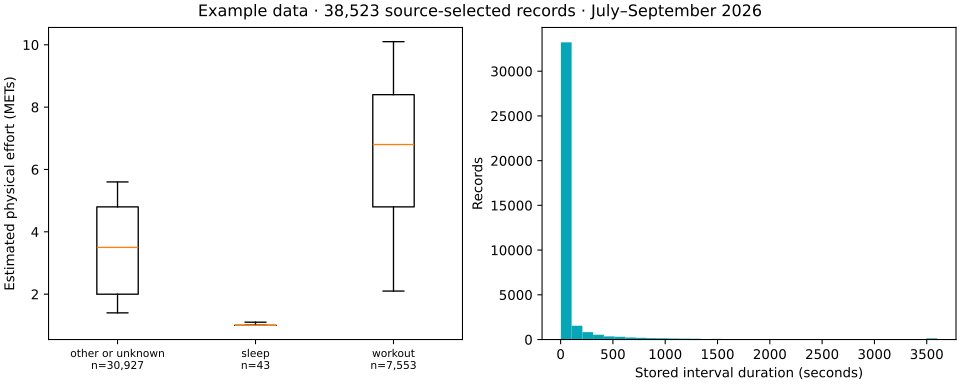
Estimated effort and stored interval duration
Example data: 38,523 records from the largest source group across 92 focus days. Workout median 6.8 METs; other or unknown median 3.5; sleep median 1.0 from only 43 intervals on eight days. These are recorded estimates, not clinical ranges.
View full-size figureHow this figure was made
July–September 2026, fixed America/Los_Angeles reporting calendar. Largest source group by focus count, grouped by bundle and display name across revisions. Equal weight per stored record. Boxes p25–p75, median line and p5–p95 whiskers; extremes retained in research but not plotted as individual points. Duration histogram includes all nonnegative intervals. Context is half-open temporal overlap with workouts and asleep categories, not explicit HealthKit association.
Is Physical Effort recorded on a fixed schedule?
No universal schedule follows from the export. In the focus example, median positive start-to-start gaps were 12.8 seconds for workout overlap and 15.4 seconds for other or unknown context. Those calculations include breaks between separately recorded periods. Some intervals approached one hour; stored intervals are not proof of the internal sensor clock.
Changes in source, software, activity mix or interval condensation can change record counts and raw averages. For a trend, retain coverage and context alongside the values; an equally weighted sample mean and a duration-weighted estimate answer different questions.
Does a higher estimate always mean a higher heart rate?
The private investigation compared source-specific reporting-day effort medians with daily heart-rate medians, running power, active-energy sums and exercise-minute sums. Relationships differed by the related source and its coverage. Running-power data overlapped only 13 focus days; cycling power was absent. A daily association cannot explain moment-to-moment physiology, establish algorithm inputs or turn METs into measured watts.
Heart rate also responds to factors beyond task demand. Keep Heart Rate, Running Power and Active Energy as complementary views rather than interchangeable effort scales.
The example included Physical Effort estimation metadata, activity type, indoor-workout flags and algorithm version. These keys are optional. Retaining them helps assess an apparent change without inventing a device capability, fitness diagnosis or clinical intensity zone.
Understanding your records
Recording frequency, source and coverage affect what you can conclude from this data. Read the recording guide.