
By PulsHealth. Updated
Real data exampleResearch reviewed . Figures use example Apple Health data.
What does Flights Climbed count?
Flights Climbed is a cumulative count of stair flights recorded during an interval. Apple supports automatic collection from iPhone, Apple Watch and Apple Watch connected to a GymKit machine. Apple’s type documentation defines the count semantics and supported sources.
It is not a count of every individual stair step, a count of building floors, or a direct measurement of total elevation gain. Stair geometry and routes vary. A flight estimate should not be treated as an exact altitude conversion without evidence from the recording source.
What do example records look like?
The reporting year contained 990 entries on 202 of 365 days. In July–September, all sources together supplied 304 entries on 56 of 92 days. Unrecorded days remain missing: they do not establish that no stairs were climbed.
The largest focus-window source group contributed 158 records on 51 days. The median interval contained one flight and the largest contained 23 flights. The selected-source observed-day raw sums ranged from 1 to 141 flights, with a median of 3. The large daily maximum needs context and source review, rather than a claim about a typical daily target.
| Question | Use | Avoid |
|---|---|---|
| How much was recorded in an interval? | Stored count | Counting individual stairs |
| How much was recorded today? | Source-aware cumulative summary | Summing overlapping devices blindly |
| How frequently are records written? | Timestamp gaps and durations | Assuming a scheduled sensor reading |
| How much height was gained? | Relevant altitude or route evidence | Exact conversion from flight count |
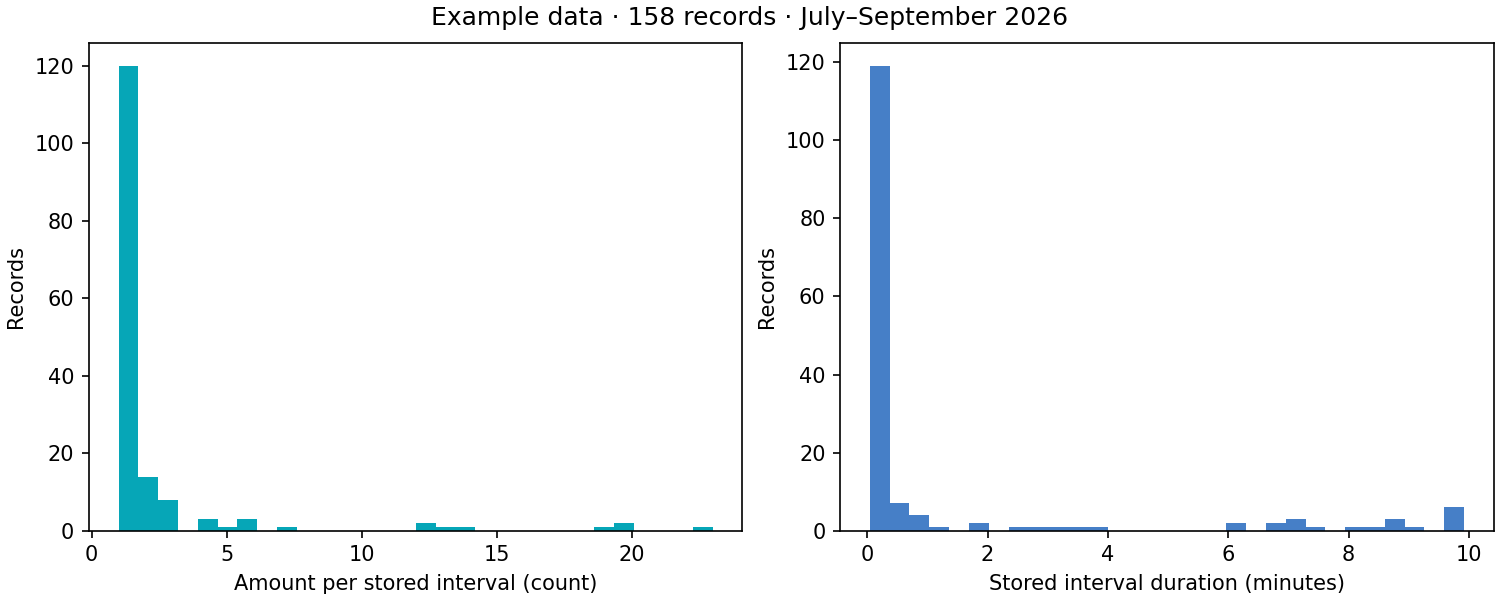
Flights Climbed: amounts and interval shape
Example July–September 2026 data from the source group with the most raw records in the focus window. Counts describe stored observations, not a recording-opportunity denominator or population norms.
View full-size figureHow this figure was made
Source selected by focus-window record count, grouping bundle identifier plus source display name and combining revisions. Half-open reporting window in America/Los_Angeles. Intervals selected by start; all retained observations plotted. Sources kept separate; no dates or source names shown.
How often are flights recorded?
This is an activity-dependent stream, not a reading expected every minute. In the selected source, stored intervals ranged from approximately 2.57 seconds to 9.92 minutes, with a median near 2.57 seconds. The same count can therefore span very different durations.
Dividing flights by interval duration describes a stored interval ratio. It does not prove the actual time spent climbing or a reliable instantaneous stair-climbing speed. Long gaps can mean no exported stair observation, incomplete wear or another recording circumstance; the raw stream alone cannot distinguish those explanations.
How do workouts, sleep and other sources affect interpretation?
The source-aware year analysis found flights overlapping workouts, with many records outside workouts. No recorded-sleep overlap was found in this snapshot; that is a result of the available sleep and flight records, not a guarantee about all users or an inference about unrecorded nights.
Temporal overlap does not establish workout linkage or stair geometry. Indoor machine records and outdoor movement need their source context. Multiple devices can register the same activity, and overlapping intervals must be investigated before combining counts.
How does Flights Climbed relate to steps and distance?
Steps capture walking volume, while walking/running distance captures horizontal travel estimates. Neither uniquely determines stair flights. Many steps can occur on flat ground, and a short route can involve substantial ascent.
In the selected source, flight counts and step totals showed only a weak exploratory daily association across the 51 days with flight records (Spearman correlation 0.20). Missing flight days were not filled with zero. The association does not isolate stair exercise, terrain or device wear, and does not predict cardiovascular fitness.
What should be checked before interpreting an outlier?
Inspect the contributing intervals, their source and whether they overlap another stream. All observed focus counts were nonnegative integers; descriptive statistical flags were retained for review rather than deleted. A long tail is plausible in a cumulative activity count and is not itself a medical alarm.
Use comparable source coverage and repeated patterns for activity tracking. There is no universally healthy daily flight range in this article, and raw counts cannot establish exertion, symptoms or suitability of stair exercise.
Understanding your records
Recording frequency, source and coverage affect what you can conclude from this data. Read the recording guide.