
By PulsHealth. Updated
Real data exampleResearch reviewed . Figures use example Apple Health data.
What does Headphone Audio Exposure measure?
Headphone Audio Exposure describes audio from headphones as equivalent continuous sound-level intervals. The display unit is dB(A) and the exported canonical unit is dBASPL. Apple’s HealthKit documentation defines the interval-level quantity and automatic iPhone/Apple Watch collection.
This differs from a volume-slider percentage. The same percentage can produce different sound levels with different headphones or content. Apple’s measurement guide says Apple and Beats headphones offer the most accurate measurements; other headphones can use estimates based on iPhone volume.
What do example records look like?
The reporting year contained 2,906 records. The largest July–September source supplied 808 intervals on 75 of 92 days. Its median was 59.5 dB(A), the middle half 54.8–62.8, and the observed minimum and maximum 8.0 and 96.0 dB(A). Those extremes are retained for source and interval review, rather than discarded as inconvenient observations or interpreted as a personal safety verdict.
| Example property | Result | Meaning |
|---|---|---|
| Stored durations | 0.03 seconds to about 30 minutes | Records have very different weights |
| Median duration | About 3.85 minutes | A stored interval, not the listening session length |
| Workout overlap | 131 records | Playback and workout timing coincide |
| Sleep overlap | None in the selected source | No exported overlap; not proof of non-use |
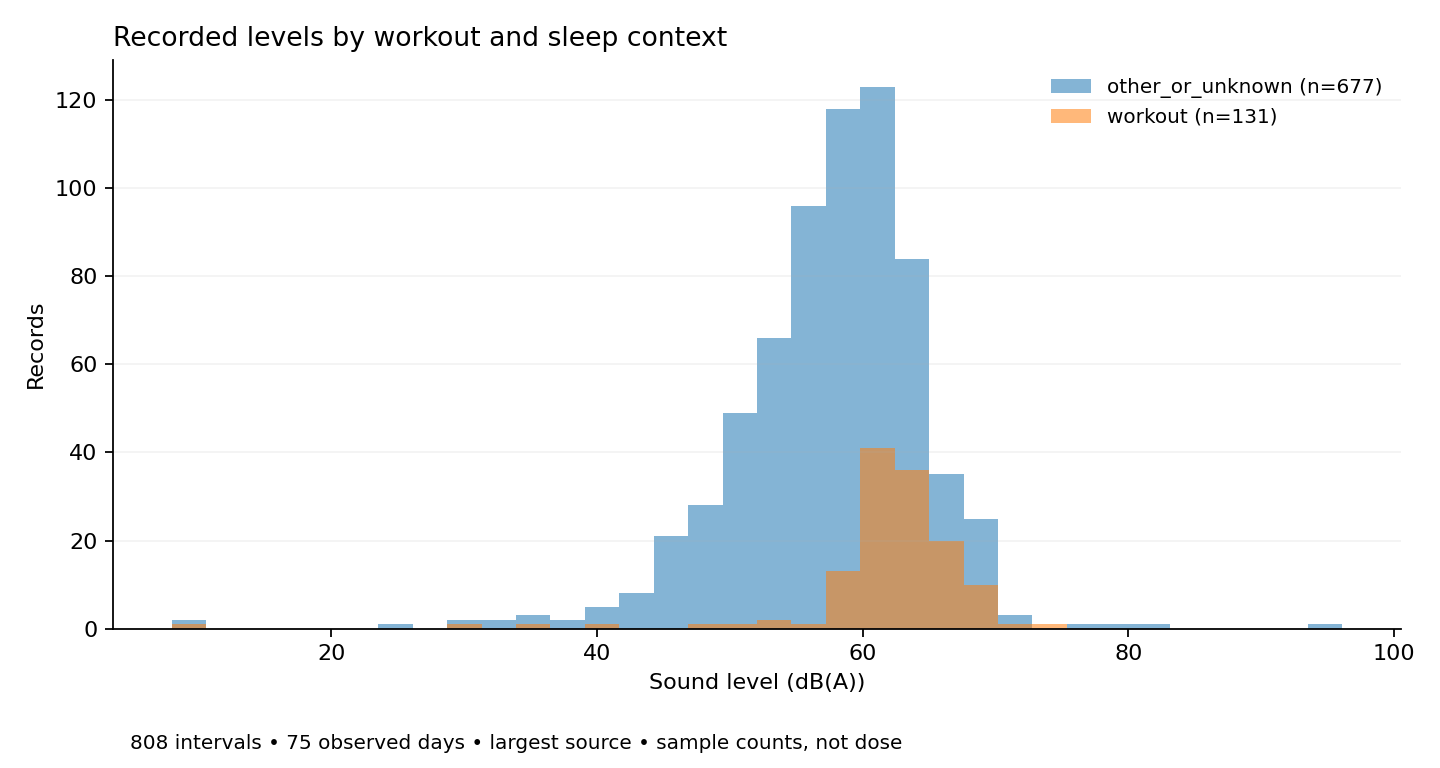
Headphone Audio Exposure: observed distribution
Example July–September 2026 records (808 intervals) from the source group with the most observations. Sample-count weighting, not duration-weighted exposure or a hearing dose. Context groups can have very different coverage.
View full-size figureHow this figure was made
Half-open reporting window, intervals selected by start in America/Los_Angeles. Source bundle identifier plus display name, combining revisions; sources kept separate. Overlap with recorded workouts takes precedence over recorded asleep intervals; other records labeled other or unknown. Boundary intervals retained without prorating.
Why do louder and longer intervals matter differently?
Sound exposure depends on both level and duration. A record-count histogram shows where observations fall, but a large pile of short, quiet samples can mask fewer long, loud ones. Decibels must be converted to an energy scale before combining levels, with durations used as weights.
Coverage still matters after that calculation. 222 intervals in the selected source began before the preceding running maximum end, including small timestamp overlaps. Blindly summing durations or mixing source groups can double-count time. The analysis records these overlaps and keeps its energy-based summaries descriptive; it does not reconstruct the Health app’s seven-day notification budget.
How does recording differ during workouts and sleep?
Another, much sparser source supplied 96 focus-window records on ten days, of which 88 overlapped workouts. The largest source supplied considerably more records outside workouts. This source mix changes the apparent relationship between listening and exercise, so the figure uses one source rather than silently pooling devices.
No sleep overlap was found in the focus-window headphone records. That result cannot explain why: playback, wearing patterns, source coverage and exported sleep boundaries are not fully observed. Start gaps describe recording cadence, not a fixed listening schedule or continuous monitoring clock.
What is a headphone notification?
Headphone Audio Exposure Event is a separate notification category. Apple’s notification guidance gives 80 dB for 40 hours across seven days as an example exposure limit and distinguishes notifications from the Reduce Loud Audio setting. Media exposure, rather than phone calls, contributes to that notification calculation.
The checked year contained headphone-level data but no headphone notification records. Absence of notifications does not certify safe exposure: feature configuration, supported sources and observation completeness remain relevant.
How should this be combined with environmental sound?
Environmental Audio Exposure and Environmental Sound Reduction add context, but neither is an interchangeable playback measurement. Daily associations in these records are exploratory, source-dependent summaries. They do not prove that attenuation causes lower volume, or provide a complete combined ear-level dose.
Understanding your records
Recording frequency, source and coverage affect what you can conclude from this data. Read the recording guide.