
By PulsHealth. Updated
Real data exampleResearch reviewed . Figures use example Apple Health data.
What does Environmental Sound Reduction mean?
Environmental Sound Reduction estimates the difference in surrounding sound intensity while wearing supported headphones that reduce environmental sound. Apple’s documentation defines this separate quantity. It describes attenuation, not headphone playback volume or the remaining sound reaching the ear.
The export uses the canonical sound-pressure unit dBASPL; the displayed difference is expressed in dB. A larger value describes more estimated reduction in the recorded conditions. It does not establish a universally safe environment or a product’s performance in every situation.
What does example sound reduction look like?
There were 1,201 records in the reporting year. The largest July–September source supplied 413 intervals on 72 of 92 days. Values ranged from 1.0 to 27.5 dB, with a median of 17.7 dB and a middle half from 5.5 to 24.7 dB.
| Question | Example result | What it cannot establish |
|---|---|---|
| How long is a stored interval? | About 5 seconds to 30 minutes | Constant attenuation throughout that interval |
| Typical interval duration? | Median 10.5 minutes | A fixed sensing schedule |
| Is it present during workouts? | 145 of 413 intervals overlap workouts | Exercise improves attenuation |
| Is it present during sleep? | No sleep overlap in this source | Headphones were never used overnight |
The second source contributed only 25 intervals on 13 days, including one sleep overlap. That sparse source cannot support a reliable sleep-versus-workout comparison. Missing days were retained as missing, rather than zero reduction.
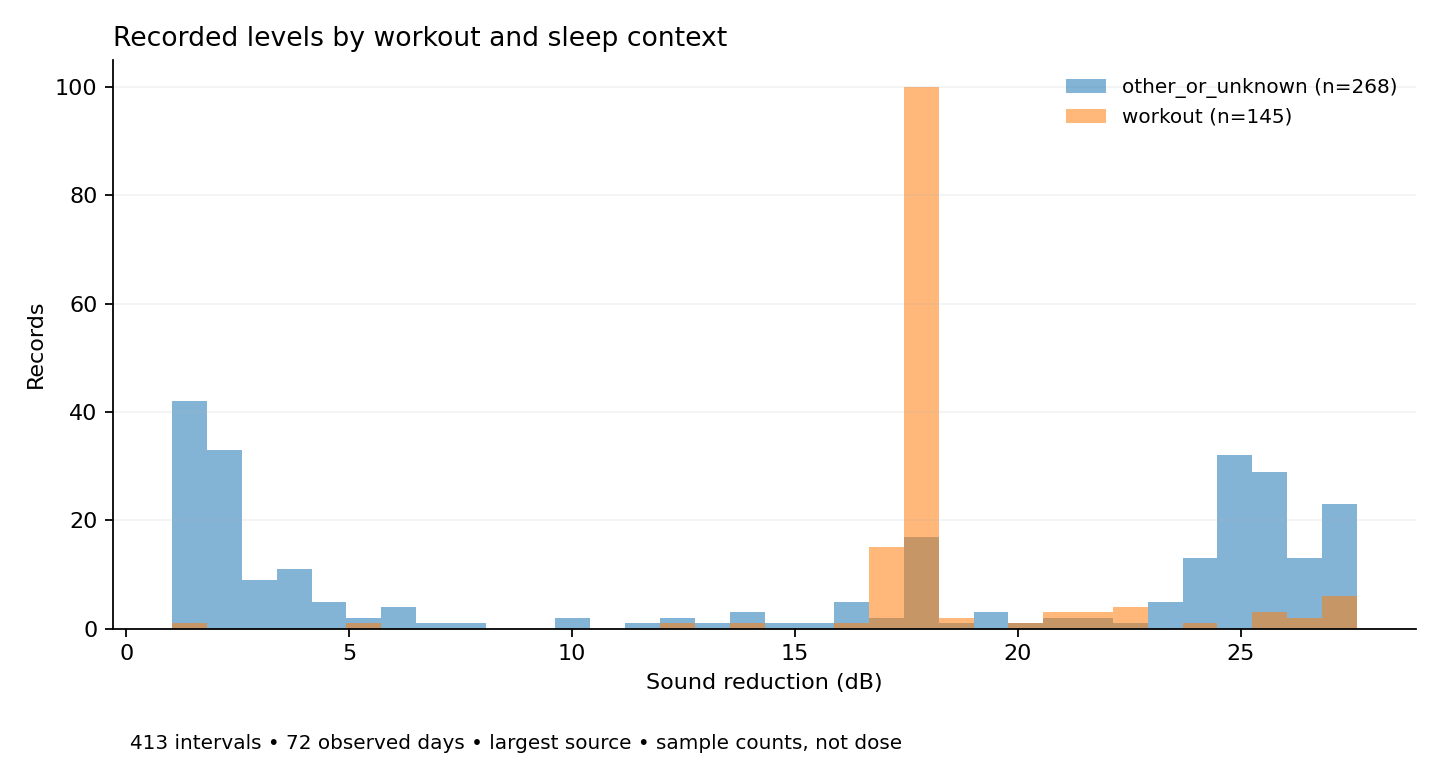
Environmental Sound Reduction: observed distribution
Example July–September 2026 records (413 intervals) from the source group with the most observations. Sample-count weighting, not duration-weighted exposure or a hearing dose. Context groups can have very different coverage.
View full-size figureHow this figure was made
Half-open reporting window, intervals selected by start in America/Los_Angeles. Source bundle identifier plus display name, combining revisions; sources kept separate. Overlap with recorded workouts takes precedence over recorded asleep intervals; other records labeled other or unknown. Boundary intervals retained without prorating.
Can sound reduction be averaged or subtracted from surrounding sound?
Medians and quantiles describe the distribution of attenuation estimates. They are not equivalent ear-level exposure. An energy average of attenuation numbers alone lacks the incident sound levels needed to estimate total protected exposure; the notebook explicitly marks that reconstruction unsupported.
Subtracting a watch’s environmental level from an unrelated headphone observation is also unreliable. The streams can cover different times and acoustic positions. Here, 44 intervals began before the preceding running maximum end, including small timestamp overlaps. Resolve coverage, source identity and temporal matching before deriving a combined value.
Is this the same as Apple’s Hearing Protection feature?
The presence of this HealthKit quantity does not confirm that a particular Hearing Protection feature was enabled or appropriate. Apple’s current Hearing Protection guide specifies supported products, configuration and fit requirements, and limitations for impulse sounds and sustained levels above 110 dBA. Avoid interpreting every noise-cancelling headphone as certified protection or treating a reduction value as permission to extend exposure.
How does this relate to headphone audio levels?
Headphone Audio Exposure measures playback levels; Environmental Audio Exposure measures surrounding sound. The research compares their source-specific daily sample summaries only on jointly observed days. These exploratory associations cannot isolate fit, listening mode, volume choices or surroundings.
A change in reduction can prompt a review of device context and repeated comparable observations. The raw quantity alone does not diagnose poor fit, a failing microphone or hearing damage, and there is no clinical normal range for attenuation in this article.
Understanding your records
Recording frequency, source and coverage affect what you can conclude from this data. Read the recording guide.