
By PulsHealth. Updated
Real data exampleResearch reviewed . Figures use example Apple Health data.
What does Time in Daylight count?
Time in Daylight is a cumulative duration. HealthKit stores time amounts, and the export uses minutes. Apple’s type documentation defines those cumulative semantics. An individual interval can contain fewer daylight minutes than its wall-clock duration.
Apple’s Watch guide describes outdoor daylight estimates from the ambient light sensor and the Motion Calibration & Distance setting used for tracking. A covered or unworn watch, configuration changes and recording coverage can affect what appears in the stream.
What do example daylight records look like?
The reporting year contained 5,850 records. The largest July–September source supplied 1,988 intervals on 88 of 92 days. Every stored interval lasted five minutes, while recorded daylight amounts ranged from one to five minutes. Those are two different quantities: interval duration is not automatically the amount to add.
Source-specific daily raw sums ranged from 3 to 319 minutes on observed days, with a median of 85.5 minutes and a middle half of 57–133 minutes. These are example observed-day totals, not a daily prescription or a population reference range. Four days with no records were not filled with zero.
| Quantity | Example | Correct use |
|---|---|---|
| Wall-clock interval | Five minutes | Locate the observation in time |
| Recorded daylight amount | One to five minutes | Add source-aware cumulative amounts |
| Daily source sum | 3–319 minutes | Describe observed-day coverage |
| Missing day | No records | Keep as unknown |
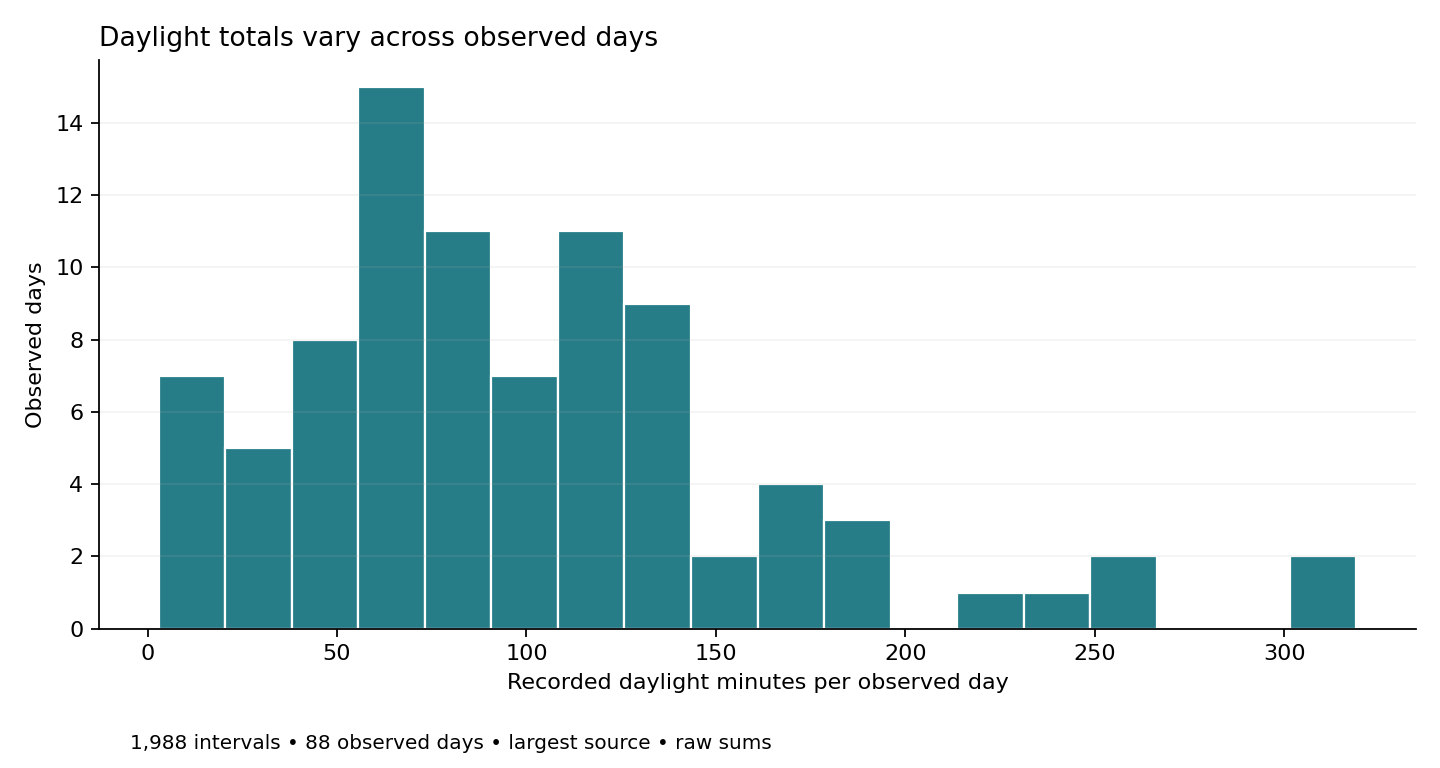
Time in Daylight: observed distribution
Example July–September 2026 records (1,988 intervals) from the source group with the most observations. Daily cumulative raw sums on 88 observed days; missing days omitted.
View full-size figureHow this figure was made
Half-open reporting window, intervals selected by start in America/Los_Angeles. Source bundle identifier plus display name, combining revisions; sources kept separate. Daylight amounts summed by reporting day, not interval durations.
Does five-minute recording mean continuous tracking?
This example has five-minute intervals, often adjacent within a recording run, separated by longer gaps. That pattern describes the exported records rather than a guaranteed sensor schedule. The selected source had no interval overlaps, no cross-midnight intervals and no amounts exceeding their stored duration. Another source contributed 36 intervals on eight days, so pooling sources still needs care even when each stream is internally tidy.
Daily sums use the reporting calendar and interval start. Travel, changed phone calendars or boundary-crossing intervals in other datasets need explicit handling. Source-specific sums are also not a promise to reproduce the Health app’s merged source-priority total.
How does daylight relate to exercise and sleep?
In the selected source, 539 intervals overlapped workouts and 1,449 were outside recorded workouts. No intervals overlapped recorded sleep. The pattern is consistent with daytime recording, but does not prove a workout was outdoors or that every outdoor activity was detected.
The notebook compares daylight totals with Step Count using only jointly observed days and separate sources. Associations differed substantially across step sources, including one close to zero. This sensitivity is a useful reason to inspect device coverage before attributing a daylight increase to more walking. There is no adjustment for weather, season, work routine or watch wear in that comparison.
Does it measure UV exposure or vitamin D?
No. Duration alone does not supply UV intensity, exposed skin area, sunscreen use, weather, spectral light or vitamin D status. The stream also cannot establish a precise circadian light dose or diagnose a sleep problem. Sleep Analysis provides timing context, but a temporal association does not establish that daylight caused a change in sleep.
Use repeated observations with comparable coverage to understand when daylight time was recorded. Review an unusually high day’s contributing intervals, source and calendar before treating it as a behavioral change.
Understanding your records
Recording frequency, source and coverage affect what you can conclude from this data. Read the recording guide.