
By PulsHealth. Updated
Real data exampleResearch reviewed . Figures use example Apple Health data.
What does this number mean?
Diastolic pressure is the lower number, reflecting arterial pressure between heart contractions. Blood pressure is normally written as systolic/diastolic, such as 120/80 mmHg. Interpret both numbers together: one component alone can miss an elevated reading in the other.
HealthKit supports separate quantity samples and a blood-pressure correlation that groups the components. A matching timestamp in an exported database does not prove membership in that correlation. See Blood Pressure for the pairing distinction.
What did example Apple Health data show?
The October 2025–September 2026 research window contained 39 diastolic samples on 17 reporting days, recorded in January and April. July–September contained none. This describes available records, not year-round monitoring or a clinical baseline.
| Feature | Example records |
|---|---|
| Minimum–maximum | 66–88 mmHg |
| Median | 75 mmHg |
| Middle 50% | 71.5–78 mmHg |
| Source grouping | 29 automation-source records; 10 tracking-app records |
| Sample interval | All instantaneous: start and end were equal |
| Missing calendar days | 348 of 365 had no record |
The figure keeps systolic and diastolic distributions separate. Repeated timestamps are retained rather than silently deduplicated. A recording source describes the app that wrote the data; it does not establish the cuff, operator, posture or clinical setting.
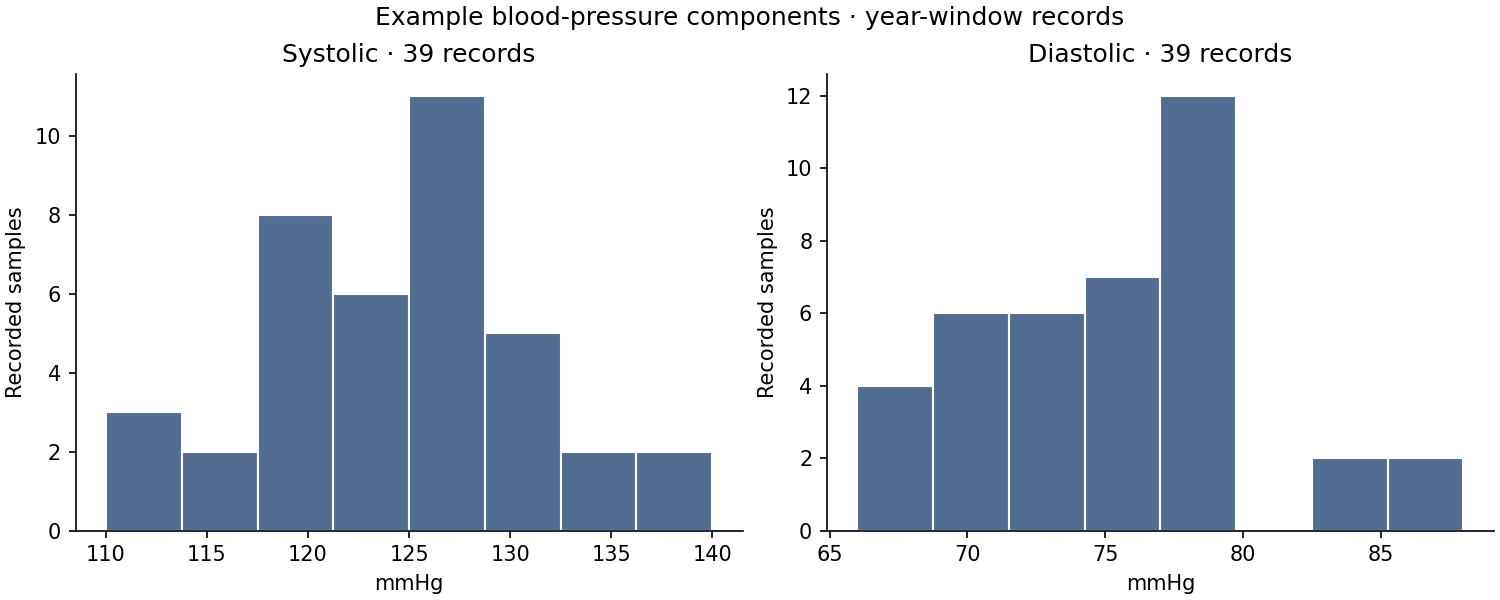
Recorded blood-pressure components
Example year-window records: 39 observations per component on 17 reporting days. Repeated timestamps remain; these are distributions of component rows, not confirmed paired cuff readings or population ranges.
View full-size figureHow this figure was made
Start-selected October 2025–September 2026 snapshot; America/Los_Angeles coverage calendar. Eight histogram bins per component; all sources and duplicates retained. No dates, identities or source names displayed. Components are not joined.
How often is blood pressure recorded?
There is no universal HealthKit schedule. A connected monitor may upload a reading after each cuff measurement, while an app or automation can log imported or manually entered values. In these records, the automation-source median positive start gap was approximately 24 hours, compared with 155 seconds in the tracking-app source. Both summaries include gaps between sessions, so neither is a recommended measurement interval.
Ten successive automation-source starts had zero timestamp gaps. The shortest positive tracking-app gap was one second, and the longest automation-source gap was about 79 days. Such patterns call for checking entry/import behavior before treating every row as a fresh cuff inflation.
How can I make home readings comparable?
Recording in the morning does not prove a standardized resting measurement. The saved observations do not supply all of the measurement conditions needed for a like-for-like comparison.
For comparable home readings, the American Heart Association recommends a validated monitor, correct cuff size, a quiet seated rest, supported positioning and repeated readings. Record the conditions consistently; exercise-adjacent measurements should not be pooled indiscriminately with rested home measurements.
Which values need a closer look?
Four of ten tracking-app diastolic rows exceeded that small source/context group’s 1.5-IQR fences; all were retained. No automation-source rows were flagged. Narrow distributions can make modest differences look statistically unusual. A statistical flag is not a diagnosis. Conversely, a value can need clinical review without being unusual within this small dataset. Recheck unexpected values against the original device, technique, units and symptoms.
| Adult blood-pressure category | Systolic | Diastolic |
|---|---|---|
| Normal | Below 120 | and below 80 |
| Elevated | 120–129 | and below 80 |
| Stage 1 | 130–139 | or 80–89 |
| Stage 2 | 140 or higher | or 90 or higher |
These AHA categories use mmHg and should be assessed with repeated, properly obtained readings. They do not diagnose hypertension from an isolated HealthKit row; individual treatment targets may differ. Blood pressure above 180 systolic and/or 120 diastolic requires prompt reassessment and medical advice. With symptoms such as chest pain, shortness of breath or new neurological symptoms, seek emergency care.
How does it relate to other HealthKit types?
Compare with Systolic Blood Pressure using verified paired measurements where available. Here, exact start/end/source matching produced 59 candidate combinations from 39 records per component, because some matching keys were duplicated. Assigning a unique pulse pressure or blood-pressure category to those combinations would invent pairing evidence.
Source-specific reporting-day medians allowed an exploratory systolic–diastolic comparison across 16 days in the automation source. That is a day-level relationship, not 16 confirmed cuff-reading pairs. Resting heart rate and body mass can provide broader context, but sparse overlapping days, app changes and inconsistent measurement conditions prevent causal conclusions.
What should I check before analyzing an export?
Keep raw components, source revisions, units, timestamps and any actual correlation membership separate. Inspect duplicate keys before joining, use the same reporting calendar, and distinguish zero-duration observations from continuous monitoring. Compute visit or day summaries only after deciding how repeated measurements and imports should be handled. A source change or recording gap may explain a trend more readily than a physiological change.
Understanding your records
Recording frequency, source and coverage affect what you can conclude from this data. Read the recording guide.
Reference ranges
These source-specific ranges provide context; they are separate from the personal values in any data examples and do not diagnose a condition.
Adults; AHA categories use both components
- normal
- Systolic <120 and diastolic <80 mmHg
- elevated
- Systolic 120–129 and diastolic <80 mmHg
- stage 1
- Systolic 130–139 or diastolic 80–89 mmHg
- stage 2
- Systolic >=140 or diastolic >=90 mmHg
Not a diagnosis from an isolated reading; treatment targets are individualized.
| Population | normal | elevated | stage 1 | stage 2 |
|---|---|---|---|---|
| Adults; AHA categories use both components Not a diagnosis from an isolated reading; treatment targets are individualized. | Systolic <120 and diastolic <80 mmHg | Systolic 120–129 and diastolic <80 mmHg | Systolic 130–139 or diastolic 80–89 mmHg | Systolic >=140 or diastolic >=90 mmHg |